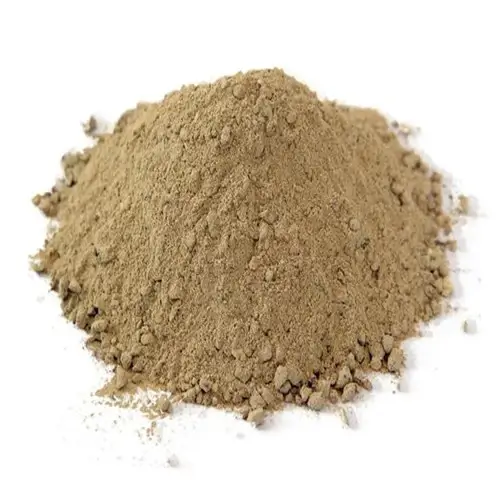
Additives for refractory materials are substances used to improve the workability (constructability), physical properties, microstructure, and performance of unshaped refractory materials. The dosage of additives varies depending on their specific properties and functions, typically ranging from a few ten-thousandths to a few percent of the total weight of the unshaped refractory mixture. They are generally added during or prior to the mixing of the unshaped refractory components.
Additives for unshaped refractory materials are classified based on their chemical composition, properties, and functional roles.
Based on their chemical composition and properties, substances are divided into two major categories: inorganic and organic:
(1) Inorganic substances: These include various inorganic salts, inorganic electrolytes, certain metallic elements and metal compounds, inorganic minerals, oxides, and hydroxides.
(2) Organic Compounds: Most belong to the category of surfactants. These surfactants possess hydrophilic and hydrophobic groups. Those with hydrophilic groups that can ionize in water are called ionic surfactants, while those that do not ionize are called nonionic surfactants. Ionic surfactants can be further classified into anionic, cationic, and amphoteric surfactants. In addition, there are also some polymeric surfactants, organic acids, and others.
Based on their functions, they can be classified into the following categories:
(1) Performance-enhancing (rheological) additives: These include water-reducing agents (dispersants), plasticizers, flocculants, and deflocculants.
(2) Curing and hardening rate regulators: These include accelerators (hardening accelerators), retarders (hardening retarders), delayed-action accelerators, and flash-setting agents.
(3) Internal structure modifiers: These include foaming agents (air-entraining agents), defoamers (de-foaming agents), anti-shrinkage agents, expansive agents, and mineralizers.
(4) Materials for maintaining workability: These include acid inhibitors (anti-swelling agents), preservatives, antifreeze agents, anti-settling agents (slurry stabilizers), and water-retaining agents.
(5) Materials for improving performance: These include sintering aids, mineralizers, quick-drying agents, and anti-explosion agents.
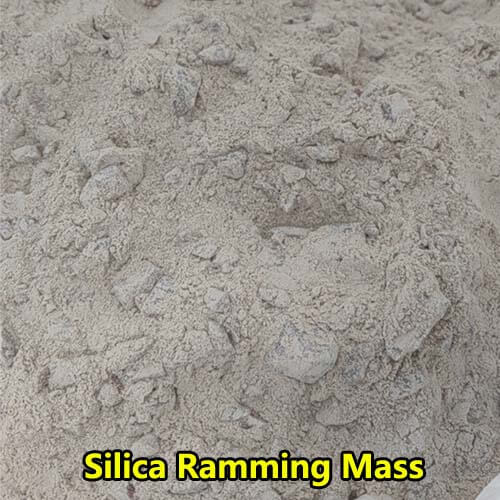
Calcium lignosulfonate
Calcium lignosulfonate is an anionic surfactant used as a water-reducing agent in concrete engineering and as a binder or bonding agent in refractory and metallurgical applications. Main uses:
(1) Water-reducing agent
① Suitable for cast-in-place and precast concrete projects, particularly for ready-mix concrete, mass concrete, and pumpable concrete.
② Used in the formulation of water-reducing agents for early strength, freeze protection, pumpability, and air-entraining properties.
③ Used to formulate various liquid water-reducing agents.
(2) Binder
① Mineral powder binder: Improves smelting recovery rates.
② Used in refractory materials: Acts as a binder to enhance refractory performance, increase strength, and prevent cracking.
③ Ceramic products: Reduces the amount of plastic clay required, increases flowability, and improves yield.
④ Refining aids: When used with tea- and phenol-based additives during the electrolysis process, they produce dense, smooth precipitates, improving the quality and purity of the precipitates.
⑤ Casting: Used as an auxiliary binder for green sand molds and dry molds to increase bonding strength and improve mold disassembly.
Antioxidant
Antioxidants are a class of additives intentionally introduced to prevent the oxidation of carbon-containing refractory materials. The mechanism of action of antioxidants is as follows: at the operating temperature, antioxidants have a greater affinity for oxygen than carbon does; they preferentially capture oxygen, thereby oxidizing themselves and protecting the carbon; After oxidation, the antioxidant expands in volume, forming a dense protective layer on the surface of the green body, which increases the body’s density and makes it more difficult for oxygen atoms to react with carbon.
Materials that can serve as carbon-containing antioxidants include metal and alloy powders, carbides, nitrides, and borides, as shown in Table 2-5.
The selection of antioxidants can be determined based on the standard free enthalpy of reaction between the antioxidant and oxygen. From the intersection of the reaction curves of various antioxidants with oxygen and the 2C + O₂ → 2CO curve, it can be determined that antioxidants are effective below this temperature, while those above this temperature cannot inhibit carbon oxidation.
Water-reducing agent
The function of a water-reducing agent is to significantly reduce the amount of mixing water required while keeping the flow value of refractory castables essentially unchanged; it is also known as a water-reducing admixture. The water-reducing agent itself does not undergo a chemical reaction with the material components but merely exerts a physical-chemical effect at the surface (interface). It is typically an electrolyte or a surfactant. The mechanism of action for electrolyte-based agents lies in their ability to dissociate into charged ions upon dissolution in water. These ions are adsorbed by solid particles (or colloidal particles) in the suspension, thereby increasing the zeta potential on the particle surfaces, enhancing the repulsive forces between particles, releasing the free water trapped within the aggregate structure formed by the fine particles, and causing the particles to disperse uniformly. For this reason, they are also referred to as dispersants. Because free water is released from the agglomerated structures, the flowability of the castable is improved, enhancing its workability.
The mechanism of action of organic surfactants is as follows: they adsorb onto the surfaces of particles in the suspension, forming a polymeric adsorption film that weakens the attractive forces between particles while increasing the repulsive forces. The potential energy of repulsion stems from the volume restriction effect or osmotic pressure restriction effect caused by the adsorbed macromolecules. This causes the particles within the agglomerate structure to disperse, releasing the entrapped water and improving the workability of the castable.
For refractory castables using calcium aluminate cement, binding clay, and oxide micropowders as binders, the water-reducing agents employed include inorganic types such as sodium pyrophosphate, sodium tripolyphosphate, sodium tetrapolyphosphate, sodium hexametaphosphate, sodium superphosphate, and sodium silicate. Organic types include lignin sulfonates (sodium or calcium), naphthalene-based water-reducing agents (such as sulfonates of naphthalene or its homologues condensed with formaldehyde), water-soluble resin-based water-reducing agents (such as sulfonated melamine-formaldehyde resin, commonly referred to as melamine-based water-reducing agents), as well as sodium polyacrylate and sodium citrate.
Dispersant
A dispersant is a substance that reduces the aggregation of solid or liquid particles in a dispersion system.
Dispersants are generally classified into two major categories: inorganic dispersants and organic dispersants. Commonly used inorganic dispersants include silicates (such as water glass) and alkali metal phosphates (such as sodium tripolyphosphate, sodium hexametaphosphate, and sodium pyrophosphate). Organic dispersants include triethylhexyl phosphate, sodium dodecyl sulfate, methyl pentanol, cellulose derivatives, polyacrylamide, guar gum, and polyethylene glycol esters of fatty acids.
Plasticizer
A plasticizer is a substance that enhances the plasticity of wet refractory mixes, or enables wet mixes to undergo plastic deformation under external forces without cracking or disintegrating. Also known as a plasticizing agent, it is an additive used in plastic and rammed refractory materials; some castable refractories and refractory slurries also contain plasticizers.
The function of plasticizers is to enhance lubrication and adhesion between particles in the mixture, ensuring that particles maintain continuous contact and do not fracture even when displaced. Plasticizers are a class of viscous substances or surfactants. Common plasticizers used in unshaped refractory materials include plastic clay, bentonite, talc powder, ultrafine oxide powders, dextrin, methyl cellulose, lignin sulfonates, and alkylbenzene derivatives.
Coagulant
Substances that shorten the setting and hardening times of refractory castables after application are called setting accelerators (or hardening accelerators). The mechanism of action of setting accelerators is relatively complex and varies depending on the properties of the binder and the accelerator used. For example, accelerators used with calcium aluminate cement are substances that promote the accelerated release of cations (Ca²⁺) and anions from calcium aluminate minerals. This accelerates the hydrolysis and hydration reactions of the minerals in the cement paste, thereby promoting the rapid formation and precipitation of hydration products. In contrast, accelerators used with acidic phosphate binders are active substances that promote acid-base reactions, thereby accelerating the chemical reactions that generate new binding phases. Therefore, different binders require accelerators with different properties.
Accelerators used in castables bonded with calcium aluminate cement are mostly alkaline compounds, such as NaOH, KOH, Ca(OH)₂, Na₂CO₃, Na₂SiO₃, triethanolamine, lithium salts, and silicate cement. Setting accelerators used in phosphate-bonded castables include: active aluminum hydroxide, talc, NH₄F, magnesium oxide, and calcium aluminate cement. Setting accelerators used in water glass-bonded castables include sodium fluorosilicate, aluminum phosphate, sodium phosphate, metallic silicon, lime, dicalcium silicate, glycolaldehyde, and CO₂.
Retarder
Substances that delay the setting and hardening of refractory castables are called retarders. The mechanism of action of retarders varies depending on the properties of the binder and retarder used. For castables bonded with calcium aluminate cement, the mechanism of action of retarders involves the following two aspects:
(1) The retarder forms complexes with cations (Ca²⁺, Al³⁺) dissociated from the binder, thereby inhibiting the formation of hydration products or the crystallization and precipitation of reaction products, thus prolonging the setting and hardening times.
(2) The retarder adsorbs onto the surface of cement particles and forms a film, preventing the hydrolysis of cement particles and inhibiting the rate of hydration reactions, thereby delaying setting and hardening. However, the aforementioned mechanisms of action vary depending on the properties of the retarder used.
Retarders are primarily used in castables bonded with calcium aluminate cement containing fast-setting minerals. Suitable retarders include: low concentrations of NaCl, KCl, MgCl₂, CaCl₂, AlCl₃, citric acid, tartaric acid, boric acid, gluconic acid, sodium gluconate, ethylene glycol, isopropyl alcohol, glycerol, starch, phosphates, carboxymethyl cellulose, and lignosulfonates.
Preservative
Substances that can maintain the working properties of unshaped refractory materials—or keep them from changing significantly—for a certain period of time after storage are called curing agents. For example, in aluminum-silicate refractory plastic or ramming mixes bonded with phosphoric acid or aluminum acid phosphate, the phosphoric acid or aluminum acid phosphate reacts with the alumina (Al₂O₃) in the material to form insoluble aluminum orthophosphate. This tends to cause the mixture to dry out prematurely, resulting in a loss of working properties (plasticity). Therefore, it is necessary to add a retarder capable of forming complexes with Al³⁺ ions to inhibit the formation of insoluble aluminum orthophosphate and extend the storage life.
Chemical substances that can be used as retards for plastic or ramming mixes bonded with phosphoric acid or acidic phosphates include: oxalic acid, citric acid, tartaric acid, acetone, 5-sulfosalicylic acid, and dextrin, In addition, there are CrO₃, diacetone alcohol, ferric phosphate, and certain organic compounds; however, oxalic acid is generally preferred in industrial applications due to its superior effectiveness and relatively lower cost.
Tartaric acid, acetone, 5-sulfosalicylic acid, dextrin, etc., as well as CrO₃, diacetone alcohol, ferric phosphate, and certain organic compounds; however, oxalic acid is generally preferred in industrial applications due to its superior performance and relatively lower cost.
Shrink-resistant agent
Substances that compensate for the shrinkage of unshaped refractory materials during heating and use after construction and shaping are called anti-shrinkage agents, also known as volume stabilizers or expansive agents. The amount of anti-shrinkage agent added is determined based on the amount of shrinkage generated during use, generally amounting to a few percent of the total composition. There are three main methods for preventing shrinkage:
(1) Thermal decomposition method. During high-temperature heating, the anti-shrinkage agent undergoes thermal decomposition. The molar volume of the decomposition products is greater than that of the reactants before decomposition, thereby compensating for the material’s sintering shrinkage. For example, when using kyanite as an anti-shrinkage agent, it is heated to 1300–1400°C. Lanite thermally decomposes into 3Al₂O₃·2SiO₂ and SiO₂, producing a volume expansion effect of 10%–12%.
(2) High-temperature chemical reaction method. After undergoing a high-temperature chemical reaction, the molar volume of the new phase is greater than that of the original reactants, thereby compensating for sintering shrinkage. For example, in aluminum-magnesium or magnesium-aluminum casting materials, adding an appropriate proportion of α-Al₂O₃ powder and MgO powder utilizes the volume expansion effect generated by the high-temperature reaction between Al₂O₃ and MgO to form spinel (MgAl₂O₄), which compensates for sintering shrinkage.
(3) Phase Transformation Method. Materials that undergo a phase transformation during heating are added; the greater molar volume of the transformed crystals compared to the pre-transformation crystals is utilized to compensate for sintering shrinkage. For example, in aluminosilicate castables or plastic refractories, adding an appropriate amount of silica powder allows quartz to transform into tridymite or cristobalite, producing a volume expansion effect of approximately 12% or 17.4%, thereby compensating for sintering shrinkage.