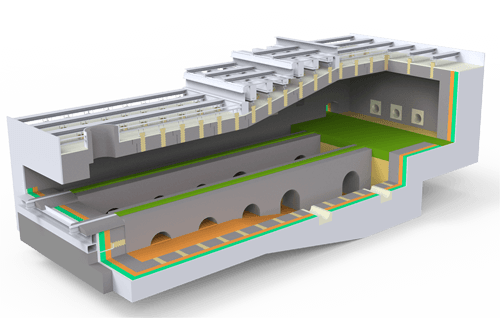
The heating furnace is a critical thermal processing equipment in steel rolling facilities. In recent years, refractory plastic has been predominantly used for the furnace roof lining in domestic heating furnaces. The specific construction process is as follows:
Anchorage installation → Billet compaction → Formwork removal → Plastic lining finishing → Perforation drilling → Contraction joint cutting and curing → Perforation sealing
1.Anchorage Device Installation
Prior to construction, install the anchoring devices—anchoring clamps—for the anchoring bricks on the furnace roof according to the design. The anchoring clamps must contact the flange surface of the I-beam on the furnace roof. If only point contact is detected, the anchoring clamps must be adjusted or replaced. The installation of the furnace roof anchoring bricks shall be performed after the plastic lining has been laid out and rammed to the corresponding position.
2.Ramming the mold
(1) Lay plasticable charge pieces in staggered, tightly packed layers, compacting sequentially layer by layer—only lay the second layer after fully compacting the first. Compact the furnace roof along the furnace’s longitudinal axis. Arrange plastic refractory blocks across the furnace width. First compact the joints between blocks, then compact horizontally from bottom to top. After compacting each layer, scrape the surface before adding and compacting the next block. Use a pneumatic tamper for plastic refractory ramming. The operator should grip the handle firmly, keeping the hammer head perpendicular to the working surface. Advance by overlapping hammer heads by 2/3 and rows by 1/2, performing 3-4 reciprocating strokes to compact the plastic refractory blocks into a dense, unified mass.
(2) When tamping reaches the furnace top anchor brick position: First, secure the wooden formwork brick with anchor hooks and wedge in wooden wedges. Use a tamping hammer to drive the wooden formwork brick into the compacted plastic mass, creating a surface matching the brick’s contours. After forming, remove the wooden formwork brick and reinstall the anchor brick. re-secure the wooden wedges, and use a hand hammer to compact the plastic mass around the bricks, ensuring tight bonding between the anchor bricks and plastic mass. Then insert the plastic mass blank for tamping. Never directly tamp the anchor bricks to prevent damage. Anchor bricks must be perpendicular to the suspension beams and must not be crooked.
(3) During extended construction breaks, leave the joint at the centerline of the same row of anchor bricks. Cover the compacted area with plastic film. When resuming compaction, roughen the surface. The compacted thickness should generally exceed the design dimension slightly to allow for post-construction trimming.
(4) Plastic ramming of the furnace roof may proceed simultaneously in sections. For sloped roofs, commence from the lower transition point. During ramming, the operator should hold the rammer horizontally. Ensure uniform compaction during construction to guarantee even stress distribution and tight bonding between refractory blocks. Select a horizontal section with minimal obstructions near the furnace door closure. Compact the closure area into a funnel-shaped recess, layering and compacting materials in stages to ensure each block achieves dense compaction.
3.Formwork removal
After tamping a 500mm length, remove the upper formwork and use a scraper to clean the top surface, ensuring a thickness of 230mm. Simultaneously inspect whether the anchoring clips and wooden wedges are secure. When removing formwork, proceed based on the hardening degree of the compacted material and the need to position the plastic rammer within the midpoint of a row of suspended bricks. Simultaneously loosen the suspension bolts front and rear, then withdraw the formwork from the suspension frame. This prevents one end of the formwork from lifting and prying the compacted material, which could cause large-scale spalling. Remove the bolts and pack the tie rod holes with plastic material formed into cylindrical shapes, tamping them firmly to prevent heat transfer.
4.Finishing of plastic materials
After finishing the plastic material tamping and removing the formwork, promptly trim the surface of the material body. Before trimming, use a wooden mallet to tap the plastic material around the anchor brick ends to ensure a tight fit. During trimming, use the anchor brick ends as a reference to remove excess material, and roughen any untrimmed surfaces.
5.Poke ventilation holes
Before the compacted plastic material hardens, drill ventilation holes with a diameter of 4–6 mm on the heated surface of the furnace top. Space these holes 150–230 mm apart, positioning them between two anchor bricks and penetrating to a depth of 1/2 to 2/3 of the compacted material’s thickness. Use specialized steel needles for drilling.
6.Cutting contraction joints and curing
Cut contraction joints strictly according to the positions indicated on the construction drawings. Joint depth: 80mm. Use V-shaped contraction joints, avoiding anchor bricks and openings during placement. Employ specialized cutting tools for the operation. For plastic-coated furnace roofs that have been trimmed and slotted but cannot be promptly fired, cover them with plastic sheeting for curing. The formation of fine water droplets on the inner surface of the plastic sheeting during the curing period is considered normal.