
By modifying the construction process of castable refractories, their performance can be significantly enhanced. Controlling the water-to-binder ratio effectively increases the bulk density of the castable, reduces porosity, and improves its resistance to erosion.
Aluminum-magnesium ladle refractories exhibit excellent properties, yet during operation, they endure significant slag erosion and molten steel erosion. Both forms of damage originate from erosion of the refractory matrix. Practical application in steel mills reveals that the matrix of aluminum-magnesium refractories frequently develops numerous cracks. Slag penetrates these cracks into the refractory interior, accelerating erosion rates and shortening the lining service life. Therefore, This paper takes Laiwu Iron and Steel as a case study to elaborate in detail on how to enhance the bulk density and erosion resistance of ladle linings while reducing crack formation.
1.Improving the Bulk Density of Ladle Casting Materials
1. Addressing the issue of raw material recycling
Field construction personnel frequently fail to use refractory castables in the specified sequence of delivery, resulting in prolonged storage times for certain materials on-site. This practice can lead to a decline in the castables’ performance characteristics. To address this issue, the workshop has intensified its assessment procedures. Personnel who violate this regulation will face financial penalties and be required to submit a written self-criticism. Following the implementation of this policy, on-site material storage has been consistently maintained below two days, significantly ensuring the stable performance of the refractory castables.
2. Strictly control the amount of water added and the vibration time
Water addition has long been a headache for on-site construction personnel. Workers across four shifts rely solely on their experience and visual judgment when adding water via hoses, stopping only when they feel the mixture is sufficiently wet. Mixing times also vary, resulting in batches that are either too dry or too wet. The quality of the ladles produced is consequently inconsistent, leading to uneven performance. Ladle life remains stagnant at around 755 pours. To address these issues, the workshop proactively sought solutions. After consensus among the workshop director and shift supervisors, it was decided to install a calibrated water tank atop the mixer. Water levels were calibrated based on required additions; when water exceeded the calibrated line, it automatically flowed out. This ensured consistent water volume per batch. Reduced water content increased bulk density, thereby enhancing erosion resistance.
Since the castable uses silica fume as a binder, its poor affinity with water necessitates sufficient mixing time to achieve optimal fluidity. Practical testing confirms that mixing for 10–15 minutes yields the best flow properties. Therefore, each batch is now mixed for precisely 10–15 minutes. This ensures excellent flowability. The fine particle size of silica fume allows it to fill voids within the castable, enhancing the ladle’s strength at ambient temperatures.
Vibration time has also been adjusted. Each batch requires vibration, but longer duration is not necessarily better. Vibration expels air from the castable, yet excessive vibration can disintegrate aggregates that have already developed bonding strength. Therefore, vibration duration is critical. Based on extensive field observations, the total vibration time must not exceed 40 minutes.
Since implementation began in June 2007, ladle life has steadily increased from an average of 75 uses before modification to the current average of 85 uses, with a single ladle achieving a maximum life of 96 uses.
2.Enhancing the erosion resistance of castable refractories
1. Strictly adhere to the curing and baking time curve
Curing is critical for ladle refractories. Insufficient curing time directly impacts the refractory’s room-temperature properties, while excessive curing time affects ladle turnover efficiency. After extensive experimentation, the standard room-temperature curing period is set at 24 hours. Following this duration, the refractory’s room-temperature strength is significantly enhanced.
The baking time must also be strictly regulated, divided into three stages:
The first stage involves low-temperature baking, primarily to remove free water from the refractory. Conducted at approximately 300°C for 24 hours, this stage eliminates 90% of the water content.
The second stage involves medium-heat baking. This stage continues to remove free water while also eliminating bound water, which is more difficult to expel. The baking temperature is around 700°C, with a duration of 24 hours.
The third stage involves high-temperature baking to further remove residual free water. At this point, free water is nearly depleted, and the castable material develops a faint reddish hue throughout. Baking occurs at approximately 1200°C for 24 hours. At 1200°C, chemical reactions begin between components within the castable, primarily involving in-situ reactions between Al₂O₃ and magnesia to form spinel. Spinel exhibits excellent resistance to erosion and thermal shock, providing superior slag erosion resistance for the entire lining structure.
2. Add large-sized high-alumina bauxite particles to the ladle bottom to enhance resistance to molten steel erosion
The ladle bottom lacks erosion resistance, and scouring has always been a persistent challenge for us. While most ladles have relatively thick walls, the bottoms have suffered severe erosion. After reviewing extensive literature, we verified that large-particle high-alumina bauxite exhibits strong scour resistance after sintering. Based on this, we coordinated with the aluminum workshop of the refractory company. They supplied 30–40mm high-alumina bauxite coarse particles. During on-site ladle bottom casting, we added 50kg of these coarse particles to each batch of castable material. After conducting several test ladles, preliminary data indicates that the coarse particles effectively enhance the castable’s erosion resistance.
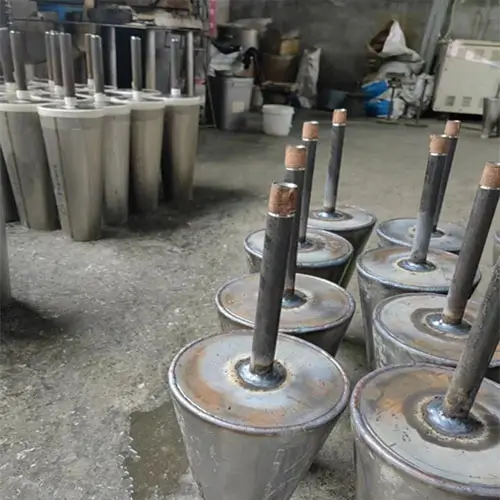
We proactively communicated and coordinated with the steelmaking department regarding various issues encountered with the ladle. To address inconsistent water addition, we installed a fixed-volume water tank, strictly controlled mixing and vibration times, resulting in reduced porosity, increased bulk density, and enhanced erosion resistance of the refractory lining. Increasing the particle size at the ladle bottom effectively strengthened the lining’s resistance to molten steel erosion. The average ladle life has increased from 75 pours before modification to 85 pours currently, with a single ladle achieving a maximum life of 96 pours.