
The application method for induction furnace repair materials depends on the type, extent, and location of the furnace lining damage, and is mainly divided into two categories: localized cold repair and hot repair. The following are common application steps compiled from publicly available information:
Localized cold repair (suitable for small-area damage)
When the furnace lining has cracks, small-area erosion, or pits, the cold repair method can be used. It does not require a complete furnace shutdown for cooling, and the operation is relatively simple.
Clean the damaged area: Thoroughly remove slag, residual iron, and loose refractory material from the damaged area to ensure a clean and solid furnace lining substrate is exposed. For cracks, widen them into a 60° V-shaped notch to increase the adhesion of the repair material.
Apply adhesive: Evenly apply a concentrated boric acid solution or water glass (sodium silicate) solution to the cleaned surface. Boric acid effectively promotes the sintering of the repair material, while water glass acts as a binder, enhancing the bond between the old and new materials.
Repair Material Filling:
Small cracks/erosion: Use the same refractory material as the original furnace lining, add 5%-6% water glass or the same amount of boric acid as the newly constructed furnace, mix thoroughly, and fill the cracks with wire, mallet, or a special tool, tamping and smoothing the mixture.
Bottom Depressions: Fill the depressions with repair material, ensuring the thickness is 20-30mm higher than the surrounding furnace lining. Then, use a flat hammer or tamping tool to firmly bind the material, scraping off any excess.
Electrical Heating: Immediately after repair, apply electricity for heating. The heating process is usually divided into two stages:
Stage 1: Apply current at 20%-60% of the rated current for 4-6 hours, gradually increasing the temperature to slowly evaporate the moisture in the repair material.
Stage 2: Increase the current to 100% of the rated current and continue heating until complete sintering, ensuring the repair material achieves sufficient strength and density.
Hot repair (suitable for large-area damage or rapid repair)
For large-area erosion or scenarios requiring rapid production recovery, hot spraying technology can be used. This technique is typically performed while the furnace is still warm.
Repair Material Preparation: Use a repair material specifically designed for induction furnaces. Its main components are fused magnesia (MgO), silicon carbide (SiC), etc., combined with binders such as high-temperature asphalt and phenolic resin. This material is self-flowing and can be rapidly sintered at a high temperature of 1600-1680℃.
Spraying Application:** Using specialized spraying equipment, with nitrogen (0.4-0.6 MPa) as the carrier gas, the dry repair material is evenly sprayed onto the damaged area of the furnace lining. This method can achieve rapid repairs up to 150mm thick with high adhesion. Sintering: After the repair is completed, the repair layer is rapidly sintered at approximately 1200℃ using residual heat in the furnace or by introducing a small amount of electricity, forming a dense and robust refractory layer. The entire process can be completed within 20-25 minutes, achieving kiln-free maintenance.
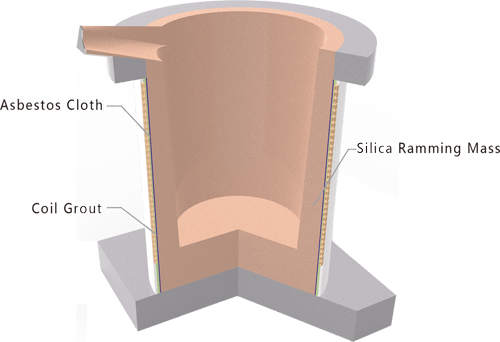
1. Important Precautions
Safety First: Regardless of the method used, ensure that there is no residual molten iron in the furnace before operation to prevent explosions or splashing accidents.
Material matching: The material of the repair material should match the original furnace lining material to avoid new cracks caused by differences in thermal expansion coefficients.
Baking is crucial: Baking is a critical step for successful repair. It must be carried out strictly according to the staged heating procedure to avoid cracking or peeling of the repair layer due to excessively rapid heating.
Professional operation: For large or complex furnace lining damage, it is recommended that professional personnel assess and perform the repair to ensure safety and effectiveness.
More details about induction furnace
What is the induction furnace?
An induction furnace is an electrical furnace in which the heat is applied by induction heating of metal. Induction furnace capacities range from less than one kilogram to one hundred tons, and are used to melt iron and steel, copper, aluminum, and precious metals.
What is the difference between electric furnace and induction furnace?
The IF (Induction Furnace) has higher thermal efficiency and can rapidly heat the charge materials. In contrast, the EAF (Electric Arc Furnace) loses a significant amount of arc heat through the furnace cover and walls.
How much electricity does an induction furnace use?
A study, undertaken for US department of energy for induction furnaces, shows an average energy consumption value for well-run heel melters up to 800 kWh/ton as compared to batch melters (530 kWh/ton) .
What are the hazards of induction furnace?
Hazards include dust inhalation, electricity, ergonomic issues, chemicals, heat, sharp objects, noise, explosives, naked flames, poor housekeeping, falling from heights, and contact with molten metal.