
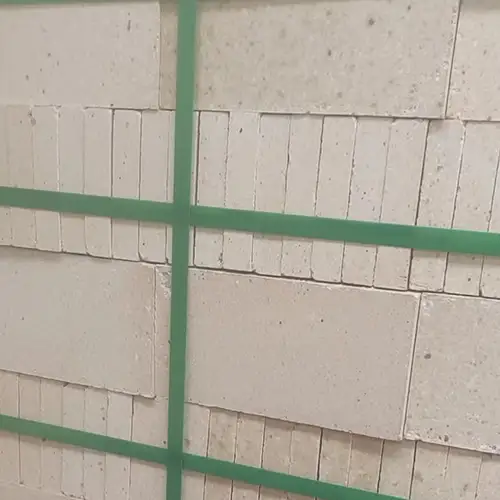
High-alumina bricks are arguably among the most widely used refractory bricks in the refractory industry. Available in hundreds of different specifications and sizes, they are suitable for use in various thermal furnaces across industries such as steel, building materials, and power generation.
Generally, aluminosilicate refractory materials with an Al₂O₃ content exceeding 48% are collectively referred to as high-alumina refractories. The shaped products are commonly known as high-alumina bricks, which are typically classified into three grades: Grade I: Al₂O₃ > 75%; Grade II: Al₂O₃ 60%–75%; Grade III: Al₂O₃ 48%–60%.
The firing temperature for Grade I high-alumina refractory bricks is typically 1700–1800°C;
The firing temperature for Grade II high-alumina refractory bricks is typically 1600–1700°C;
The firing temperature for Grade III high-alumina refractory bricks is typically 1500–1600°C;
The production process for high-alumina bricks is similar to that of multi-clinker clay bricks. The primary refractory raw materials include: high-alumina bauxite, primarily composed of hydrated alumina minerals (such as gibbsite and boehmite); silicates (including kyanite, andalusite, and sillimanite); synthetic raw materials, such as industrial alumina, synthetic mullite, and fused corundum. The key differences lie in the higher proportion of clinker in the mix—which can reach 90% to 95%—and the need to grade, sort, and screen the clinker to remove iron before crushing. Additionally, the firing temperature is higher; for example, when Grade I and II high-alumina bricks are fired in tunnel kilns, the temperature is generally 1500–1600°C.
Physical and chemical properties
The refractoriness of high-alumina bricks varies widely, generally ranging from 1770 to 2000°C. It is primarily influenced by the Al₂O₃ content, increasing as the Al₂O₃ content in the product rises. At the same time, refractoriness is also affected by the content and type of impurities and is related to the mineral phase structure of the product.
The temperature at which high-alumina bricks begin to deform under load (load-softening temperature) is greater than 1400°C and increases with rising Al₂O₃ content. For products with Al₂O₃ content below 71.8%, the load-softening temperature depends on the ratio of mullite to glass phase, increasing as the mullite content rises. The quantity and properties of the glass phase have a significant effect on the load-softening point. When the Al₂O₃ content is between 71.8% and 90%, the products consist of mullite and corundum. As the Al₂O₃ content increases, the amount of the glass phase remains essentially constant; although the amount of corundum increases, the amount of mullite decreases; therefore, the load-softening temperature does not increase significantly. When the Al₂O₃ content exceeds 90%, the amount of the glass phase decreases as the Al₂O₃ content increases, and the load-softening temperature rises significantly, from 1630°C at 90% Al₂O₃ to 1900°C at 100% Al₂O₃; the load-softening temperature increases with the increase in Al₂O₃ content.
The thermal conductivity of high-alumina bricks decreases as temperature increases. The higher the Al₂O₃ content in the bricks, the greater the proportion of mullite and corundum crystals, and the more pronounced the decrease in thermal conductivity with rising temperature. However, above 1000°C, the rate of decrease slows.
There are currently six national standards, iron and steel industry standards, and building materials industry standards pertaining to high-alumina bricks:
YB/T 4577-2016 Permeation-Resistant High-Alumina Bricks
GB/T 2988-2012 High-Alumina Bricks
JC/T 1063-2007 Spalling-Resistant High-Alumina Bricks for Cement Kilns
YB/T 4439-2014 High-Alumina Anchoring Bricks for Heating Furnaces
JC/T 350-2013 Phosphate-Bonded High-Alumina Bricks
GB/T 3995-2014 High-Alumina Insulating Refractory Bricks
Grades of High-Alumina Bricks
Standard high-alumina bricks are classified into six grades—LZ-80, LZ-75, LZ-70, LZ-65, LZ-55, and LZ-48—based on their Al₂O₃ content.
About the Production of High-Alumina Bricks
Using Grade I bauxite clinker and fused white corundum powder as raw materials, combined with an appropriate amount of expansion agent, and following shaping and heat treatment at 800°C, high-alumina bricks with good thermal shock resistance can be produced. Using Grade I bauxite clinker and fused white corundum powder as raw materials, combined with an appropriate amount of expansion agent, and following shaping and heat treatment at 800°C, high-alumina bricks with good thermal shock resistance can be produced.
To reduce the porosity of high-alumina bricks, appropriate measures must be taken at every stage of the process, from raw material selection, batching, and mixing through to forming and firing.
The water absorption of Grade I high-alumina bauxite clinker should preferably be less than 5%, while that of Grade II high-alumina material should preferably be less than 7%. Soft clay with a moisture content of less than 4% should be mixed and finely ground with the bauxite clinker. Using this finely ground mixture in the formulation can reduce the porosity of the brick green body.
For particle size distribution during formulation, a coarse-to-medium-to-fine ratio of 4:2:4 is recommended, with the maximum particle size not exceeding 5 mm. The sequence for adding materials during mixing is as follows: first add the coarse particles, then add the waste liquid from sulfite pulp and pre-mix for 3 minutes, followed by the addition of the fine high-alumina powder for mixing.
Defects caused by the firing process
Generally speaking, nearly all issues with high-alumina bricks become apparent after firing, resulting in a wide variety of defects. The primary defects include underfiring, overfiring, breakage, contamination, black cores, warping, and cracking.
1. Underburning
Underburning occurs due to insufficient firing temperature, inadequate holding time, or the ingress of cold air. Generally, underburned high-alumina bricks exhibit low mechanical strength, loose bonding, a dull sound when tapped, and are prone to breakage during handling. They also demonstrate poor high-temperature performance and resistance to erosion.
2. Overfiring
Overfiring is caused by excessively high firing temperatures, excessive holding time, or direct contact between the flame and the brick surface. Generally, overfired high-alumina bricks exhibit high mechanical strength, low apparent porosity, significant dimensional shrinkage, severe deformation, overly dense bonding, severe vitrification, a ringing sound when tapped, and very poor thermal shock resistance. However, when raw materials contain high levels of impurity oxides such as Fe₂O₃ and TiO₂, overfiring can also cause high-alumina bricks to foam, resulting in reduced density, increased apparent porosity, and greater volumetric expansion.
3. Breakage
Breakage refers to defects such as chipped edges, missing corners, and loose particles that appear after firing. Possible causes include insufficient matrix content, inadequate binder strength, excessive force during handling, uneven mixing, particle segregation, insufficient forming pressure, or low firing temperature.
4. Contamination
Contamination refers to defects such as melt voids and iron spots. Melt voids may result from low-melting materials like coal slag or foreign matter being mixed into the brick-making material, causing the high-alumina brick to melt during firing. Iron spots are dark patches caused by the oxidation and diffusion of iron-containing substances during firing, which were mixed into the raw materials during production. This may occur when iron-containing substances are introduced into the refractory raw materials during crushing or grinding.
5. Black Heart
A black heart is a defect where the center of the fired refractory product appears black. This may occur when organic matter inside the product is sealed by the resulting glass phase before it has fully oxidized. It may also result from firing the product in a reducing atmosphere followed by exposure to an oxidizing atmosphere during cooling. Generally, products with a black heart exhibit poor resistance to erosion.
6. Warping
Warping refers to the deformation of high-alumina bricks caused by pressure at high temperatures, characterized by the edges on the bottom surface of the brick not lying in the same plane. Improper forming, kiln loading, or firing can all lead to warping in high-alumina bricks.
7. Cracks
Cracks refer to various types of fissures present in refractory products after firing, including surface cracks, internal cracks, visible cracks, and hidden cracks. The causes of cracks in high-alumina bricks vary. For example, improper forming may result in layer cracking; excessive or uneven shrinkage and expansion during drying and firing can also cause cracks; and uneven heating or cooling of the brick body during firing, resulting in inconsistent firing line changes or excessive thermal stress, can lead to cracking.
The causes of cracks generally include the following:
(1) Raw material factors
Corrective measures: The primary mineral phases in high-alumina bricks consist of mullite, corundum, and a glass phase. As the Al₂O₃ content in the product increases, the proportions of mullite and corundum also increase, while the glass phase correspondingly decreases, thereby improving the product’s refractoriness and high-temperature performance. In the actual production of high-alumina bricks, attention must be paid to controlling the impurity content of the high-alumina bauxite clinker used. In accordance with the requirements of YB/T5179-2005 (High-Alumina Bauxite Clinker), the K₂O and Na₂O content should be <0.35%–0.6%. Whenever possible, raw materials with low impurity content and good sintering properties should be used for production.
(2) Slurry-related causes
The critical particle size in the slurry, the amount of fine powder added, and the quality of slurry mixing all influence the formation of cracks in semi-finished high-alumina bricks. For example, the matrix material is generally composed of fine powder, which contracts during firing, while larger particles typically expand. The significant difference in deformation between the two generates internal stress, leading to cracks in the finished product.
(3) Molding-related causes
These include issues with the brick shape, improper mold design, uneven distribution of the mixture, as well as factors related to molding operations and molding pressure.
(4) Firing-related causes
The sintering of high-alumina bricks is a liquid-phase process. The formation temperature and volume of the liquid phase, the heating rate during firing, atmospheric conditions, shrinkage of the green body during firing, and the recrystallization of corundum due to secondary mullitization can all lead to inconsistent shrinkage, causing cracks on the surface of the product.
Cracks generally occur in the preheating zone, firing zone, and cooling zone. The causes of cracking in high-alumina bricks are multifaceted, often involving the combined effect of one or more factors. However, fundamentally, cracking occurs when the applied stress exceeds the brick’s inherent stress tolerance. In actual production, microcracks resulting from physical and chemical changes in the product can sometimes be beneficial for improving thermal shock resistance. Therefore, it is essential to analyze the various factors contributing to cracking in high-alumina bricks to implement improvements and enhance the product’s yield rate.
Applications of High-Alumina Bricks
High-alumina bricks are primarily classified into standard high-alumina bricks and modified high-alumina bricks. Standard high-alumina bricks refer to commonly used, standard-fired bricks, while modified high-alumina bricks mainly include four types: high-load soft high-alumina bricks, micro-expanding high-alumina bricks, low-creep high-alumina bricks, and phosphate-bonded high-alumina bricks.
I. Standard High-Alumina Bricks
The primary mineral composition of high-alumina bricks consists of mullite, corundum, and a glass phase.
Standard high-alumina bricks are primarily used for lining blast furnaces, hot blast stoves, electric furnace roofs, blast furnaces, reverberatory furnaces, and rotary kilns. In addition, high-alumina bricks are widely used in open-hearth furnace regenerative grate bricks, plugs for pouring systems, and nozzle bricks.
II. High-Load Soft High-Alumina Bricks
Compared to ordinary high-alumina bricks, high-load-softening high-alumina bricks differ in their matrix and binder components.
(1) For the matrix, in addition to adding mullite concentrate, high-alumina materials (finely ground high-alumina bauxite, industrial alumina or α-Al₂O₃ micropowder, corundum powder, and high-alumina corundum powder) are appropriately incorporated to ensure that the post-firing chemical composition closely approximates the theoretical composition of mullite.
(2) For the binder, high-quality ball clay is selected; depending on the specific type, either a clay composite binder or a mullite-based binder is used.
By employing these methods, the load-softening temperature of the high-alumina bricks is increased by 50–70°C.
III. Micro-expanding High-Alumina Bricks
Micro-expanding high-alumina bricks are manufactured using high-alumina bauxite as the primary raw material, with the addition of tricalcium silicate concentrate, following the standard production process for high-alumina bricks. To ensure appropriate expansion of the high-alumina bricks during use, it is critical to select the right type and particle size of the tricalcium silicate (TCS) mineral, and to control the firing temperature so that the selected TCS mineral partially undergoes mullitization while retaining some TCS mineral. The residual TCS mineral undergoes further mullitization (primary or secondary mullitization) during use, accompanied by an expansion reaction. It is preferable to use composite TCS minerals, as the decomposition temperatures of individual TCS minerals vary. The expansion resulting from mullitization also varies. By leveraging this characteristic, high-alumina bricks exhibit corresponding expansion effects at different operating temperatures, which compress the brick joints and enhance the overall density of the brick, thereby improving its resistance to slag penetration.
IV. Low-Creep High-Alumina Bricks
In China, the performance metrics for clay bricks and high-alumina bricks used in hot blast stoves have long focused primarily on the load-softening temperature, with no specific requirements for creep rate. After years of use, issues such as brick deformation, cracking, and subsidence have emerged; these problems become even more pronounced when the hot blast stove air temperature is increased. With the development of large-volume, high-temperature blast furnace technology and the pursuit of longer service life, higher demands have been placed on refractory materials for hot blast stoves. These materials must withstand long-term thermal stress and high air temperatures without being easily damaged. Therefore, high-alumina bricks for hot blast stoves are required to have a low creep rate. This plays a crucial role in extending the service life of hot blast stoves. The physical and chemical properties of low-creep high-alumina bricks are as follows:
To address the creep resistance of high-alumina bricks, beneficial minerals are added to utilize so-called unbalanced reactions. When the creep temperature is 1550°C or 1500°C, the additives are quartz and tricalcium silicate; When the creep temperature is 1450°C, 1400°C, or 1350°C, the additives are tricalcium silicate, with corresponding additions of corundum and α-Al₂O₃; when the creep temperature is 1300°C, 1270°C, or 1250°C, the additives are tricalcium silicate. In these cases, minerals such as tricalcium silicate and activated alumina are primarily incorporated as a matrix, and the complete or near-complete mullitization of the matrix is critical. This is because the mullitization of the matrix inevitably increases the material’s mullite content and reduces the glass phase content, while the excellent mechanical and thermal properties of mullite contribute to the improvement or enhancement of the material’s high-temperature performance.
Research has shown that in the production of high-alumina bricks, adding 15%–35% sillimanite concentrate enables the manufacture of high-load, low-creep high-alumina bricks for blast furnace hot blast stoves with a creep temperature of 1400–1450°C. For low-creep high-alumina bricks with a creep temperature of 1500–1550°C, in addition to adding an appropriate amount of sillimanite, a certain amount of mullite must also be incorporated; alternatively, a portion of fused alumina and silica raw materials may be used.
V. Phosphate-Bonded High-Alumina Bricks
Phosphate-bonded high-alumina bricks are chemically bonded refractory products manufactured using dense, premium-grade or first-grade calcined high-alumina bauxite as the primary raw material, with phosphoric acid or aluminum phosphate solution as the binder. After semi-dry mechanical forming, they are heat-treated at 400–600°C. As a non-fired brick, to prevent excessive shrinkage during high-temperature use, the formulation must include heat-expanding materials such as kyanite, sillimanite, micaceous shale, and silica. Compared to ceramic-bonded, fired high-alumina bricks, these bricks exhibit better resistance to spalling; however, they have a lower load-softening temperature and poorer resistance to erosion. Therefore, small amounts of fused alumina and mullite are added to strengthen the matrix. Phosphate-bonded high-alumina bricks are suitable for cement kilns, electric furnace roofs, and steel ladles.