
This article reviews research progress on the primary materials used for porous plugs in refining ladles—specifically corundum-spinel (Al₂O₃-MgO), chrome-corundum, corundum-mullite, magnesia (magnesia-spinel), and oxide-non-oxide composites—and introduces the main types and development status of composite-structure porous plugs. It highlights that composite-structure porous plugs represent the mainstream trend for future development, emphasizing the need to rationally select materials for different zones based on operating conditions and to enhance performance by optimizing raw materials and mix proportions, thereby further improving service effectiveness.
In recent years, the advancement of technology and the growing demand for high-quality and specialty steels have driven the rapid development of ladle refining technologies. As a critical functional component for bottom argon purging in refining ladles, the gas-permeable plug plays a vital role in enhancing the cleanliness and quality of molten steel [1-2]. With the trend toward larger ladle capacities, higher smelting temperatures, and extended refining times, increasingly stringent requirements have been placed on the performance of these plugs—specifically regarding gas permeability, inclusion removal efficiency, service life, and operational safety [2]. The intermittent nature of bottom purging operations, the harsh service environment, and the necessity for oxygen cleaning—which severely impacts service life—have made the improvement of refractory materials and the optimization of structural designs key areas of research focus.
Common materials for refining ladle gas-permeable plugs include corundum, corundum-spinel, chrome-corundum, and corundum-mullite. To meet the demands of specialty steel production, magnesia-based (magnesia-spinel) and oxide-non-oxide composite plugs have also been developed in recent years, effectively catering to the smelting needs of various high-quality and specialty steels and marking significant progress in the field. Furthermore, various composite structural designs have been introduced to extend service life and ensure operational safety. Improvements in refractory materials and the optimization of structural configurations have collectively led to significant enhancements in both the performance and longevity of gas-permeable plugs.
1.Corundum-based porous plug
Corundum-based gas-purging bricks are functional components primarily manufactured from sintered corundum or fused white corundum. Although corundum exhibits excellent chemical stability at high temperatures, the bricks often fail to meet operational requirements due to thermal spalling and the erosive/penetrative effects of molten steel and slag—areas where pure corundum products show significant deficiencies in thermal shock resistance and slag corrosion resistance. To withstand the harsh environments of refining processes, beneficial additives such as spinel (or MgO), Cr₂O₃, ZrO₂, and mullite (or SiO₂) are incorporated into the corundum-based matrix; this has led to the successful application of variants such as corundum-spinel, Al₂O₃-Cr₂O₃, Al₂O₃-Cr₂O₃-ZrO₂, and corundum-mullite gas-purging bricks.
To reduce energy consumption, Chen Qilong et al. investigated methods to enhance the low- and medium-temperature strength and ensure volumetric stability during high-temperature firing for unburned corundum-spinel gas-purging bricks. They found that α-Al₂O₃ micropowder promotes sintering and increases material strength, with addition levels exceeding 10% being feasible. However, the CaO and Al₂O₃ introduced by the cement react to form CA6, causing volumetric expansion; excessive cement content reduces material strength, necessitating strict control over the dosage. Unburned corundum-spinel gas-purging bricks formulated with 10% active α-Al₂O₃ micropowder, 6%–9% spinel micropowder, and 4% cement can serve as effective alternatives to high-temperature fired bricks, offering significant economic and environmental benefits.
Song Yanan et al. prepared corundum-spinel gas-purging bricks using tabular sintered corundum, alumina-rich spinel powder, and alumina powder as primary raw materials, with cement serving as the binder, and investigated the influence of different types of spinel powder on the bricks’ properties. Research indicates that the introduction of ultrafine bimodal spinel micropowder results in a denser packing structure; this leads to a significant reduction in the water requirement for the castable, lower apparent porosity, and higher bulk density, as well as markedly increased strength in samples fired at various temperatures. Among the spinels tested, LISAM 10A spinel micropowder yielded the best results, significantly enhancing the slag erosion resistance of the samples.
Zhang Shengxin et al. investigated the effect of ZrO₂ additives on the thermal shock resistance of corundum-based gas-permeable bricks, focusing on phase-transformation toughening and micro-crack toughening mechanisms at high temperatures. The results showed that adding 3% ZrO₂ significantly improved the thermal shock resistance of the bricks.
Gong Shangbao studied the influence of chromium oxide micropowder on the properties of Al₂O₃-Cr₂O₃ gas-permeable bricks for steel ladles, which are primarily composed of tabular alumina. Experiments demonstrated that an appropriate amount of chromium oxide micropowder could reduce erosion and improve thermal shock resistance; the optimal addition range for Cr₂O₃ was found to be 1%–5%.
Jia Quanli et al. prepared corundum-zircon-mullite gas-permeable bricks with high thermal shock resistance using raw materials such as phenolic resin-coated corundum grains, corundum grains and fines, zircon-mullite grains and fines, alumina micropowder, silica micropowder, and hydrated alumina powder. This approach overcame the drawbacks of poor thermal shock resistance and susceptibility to spalling found in existing materials; the resulting bricks offer high gas permeability and excellent spalling resistance, thereby significantly extending their service life.
By optimizing the addition levels of raw materials—such as spinel (or MgO), Cr₂O₃, ZrO₂, and mullite (or SiO₂)—in corundum-based materials, the performance of corundum-based gas-permeable bricks has been significantly improved.
2.Magnesia-based porous plug
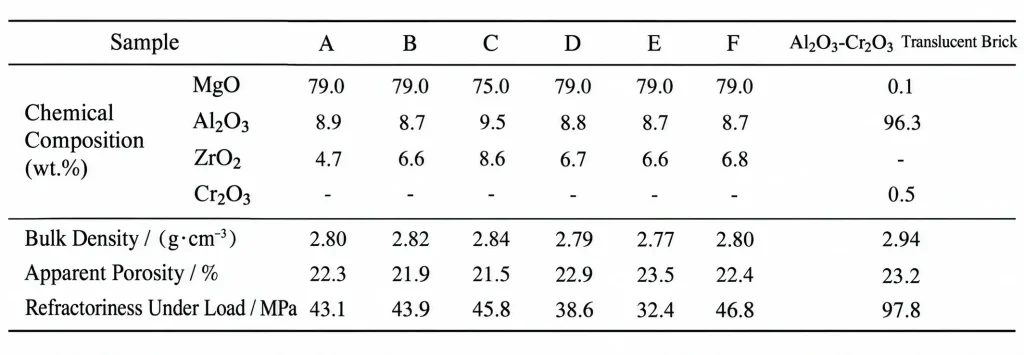
Currently used corundum-based porous plugs suffer from two major issues: molten steel penetration impairs gas permeability, necessitating oxygen lancing for cleaning; and many contain Cr₂O₃, which poses environmental risks. To develop an eco-friendly porous plug with high penetration resistance, Takayuki et al. [9] investigated the properties of magnesia-spinel porous plugs. The results demonstrated that the magnesia-spinel samples exhibited significantly better spalling resistance than Al₂O₃-Cr₂O₃ samples; the erosion thickness was merely one-tenth that of the reference samples, and the penetration depth was reduced by half. The erosion mechanism for Al₂O₃-Cr₂O₃ plugs involves molten steel penetrating the Al₂O₃-based material to form low-melting-point compounds. In contrast, magnesia-spinel plugs inhibit molten steel penetration because iron (Fe) forms a solid solution with MgO (as FeO), thereby suppressing the formation of low-melting-point compounds and enhancing penetration resistance. The newly developed MgO-based porous plugs offer superior spalling and erosion resistance compared to conventional Al₂O₃-Cr₂O₃ plugs; they exhibit minimal molten steel penetration and hold the potential to eliminate the need for oxygen lancing.
3.Oxide-non-oxide composite gas-permeable brick
Non-oxide materials such as silicon nitride and β-SiAlON offer advantages including high high-temperature strength, excellent thermal shock resistance, and poor wettability by molten metals and slag. Incorporating them into oxide materials to develop oxide-non-oxide composite gas-purging plugs holds promise for improving penetration resistance and reducing the need for oxygen-blowing cleaning. Research [10] has confirmed that corundum-silicon nitride gas-purging plugs exhibit poor wettability with slag and iron; consequently, no slag buildup occurs on the working face during service, and they demonstrate superior resistance to slag/iron erosion and better gas permeability compared to corundum-based oxide plugs. Lu Xiangyang et al. [11] fabricated SiAlON-bonded corundum gas-purging plugs using tabular corundum as the aggregate; Al₂O₃ micropowder and Si powder as the primary matrix components; and a small amount of La₂O₃ as a sintering aid. The plugs were formed via vibration casting and fired in a nitrogen atmosphere at 1,450°C. The results indicated that the material achieved optimal comprehensive properties with a Si powder addition of 9.5%. The performance metrics for plugs prepared with this formulation were: SiAlON content of 10%–15%; bulk density ≥3.1 g·cm⁻³; apparent porosity ≤15%; flexural strength (ambient temperature) ≥25 MPa; flexural strength (high temperature) 10–15 MPa; and gas permeability 10–20 m³·h⁻¹.
Jia Quanli et al. [12-13] prepared SiAlON-bonded corundum castables via in-situ nitridation, using tabular corundum as the aggregate and a matrix composed of fused white corundum fines, hydrated alumina, Si powder, and Al₂O₃ micropowder. The results showed that as the amount of SiAlON formed increased, the bulk density and ambient-temperature flexural strength of the specimens initially increased and then decreased, while the apparent porosity and permanent linear change after firing gradually increased. Optimal comprehensive properties were achieved when the SiAlON content reached 10%. Gas-purging plugs prepared using this optimal formulation exhibited significantly improved thermal shock resistance, with ambient-temperature properties and high-temperature strength comparable to those of corundum-spinel plugs. Newly developed gas-purging bricks have been put into batch application on VOD and LF ladles; compared to existing corundum-spinel bricks, they offer a 15% longer service life, a high gas-permeability rate, and ease of cleaning and operation.
4.Composite-structure gas-permeable brick
Gas-permeable bricks are primarily categorized into three structural types: diffuse, directional straight-through pore, and directional slit [14]. Slit-type bricks offer high strength and a wide range of gas flow regulation; however, they suffer from low gas-permeability rates and poor thermal shock resistance, and the issue of transverse fracturing during service has not been fully resolved. Diffuse-type bricks produce small, concentrated gas bubbles, resulting in superior refining efficiency; yet, they possess low strength and poor resistance to ablation and erosion, and their service life is significantly shortened by the oxygen-blowing cleaning processes required during later stages of use. Composite gas-permeable bricks combine the advantages of different types while mitigating their respective shortcomings. Featuring two or more types of gas channels—such as slits, straight-through micropores, and diffuse interconnected pores—composite bricks offer performance advantages unmatched by single-channel designs: (1) Broad applicability: suitable gas channel combinations can be selected based on specific smelting conditions, yielding excellent results across applications ranging from ingot casting and general construction steel to clean steel (with gas-permeability rates approaching 100%) [15-18]; (2) Superior metallurgical performance: bottom-blowing flow rates, as well as bubble quantity and diameter, can be adjusted over a wide range, ensuring high efficiency in removing fine oxide inclusions [19-22]; (3) Ease of operation and maintenance: the frequency of oxygen cleaning is low, allowing for maintenance-free operation or minimal oxygen burning, which significantly reduces labor intensity and dust/fume pollution [23-24].
Composite gas-permeable bricks fall into the following four categories: (1) Core-plate type: featuring a core plate at the working end and diffuse material in the safety layer; (2) Ceramic rod type: a composite design combining microporous ceramic rods with slits; (3) Novel diffuse type: a composite design combining slits with diffuse gas pores; (4) Permeable core replenishment type: a porous permeable core repair material is introduced during the mid-to-late service stage of slit-type bricks, creating a gas channel structure composed of both slits and diffuse gas pores. Core-plate composite gas-permeable bricks offer broad applicability and a high gas-flow rate (up to 100%). They are widely used in the refining of ordinary and special steels—including in steel plants with slow ladle turnover and harsh thermal shock conditions—thanks to a macro-structure with functionally distinct zones: the core-plate layer serves as the working layer, requiring resistance to the scouring and abrasion of high-temperature molten steel and high-pressure argon flow, resistance to erosion by molten steel and slag, and structural stability amidst rapid temperature fluctuations; meanwhile, the dispersion layer acts as a safety layer and gas chamber, providing safety alerts and ensuring uniform gas pressure distribution [23-24]. Ceramic-rod composite gas-permeable bricks incorporate rods that not only reinforce and toughen the castable matrix but also enhance resistance to wetting and penetration by molten steel, thereby preventing transverse breakage and enabling light-oxygen or oxygen-free purging. Novel dispersion-type composite gas-permeable bricks feature added slits at the edges of the dispersion components; this design overcomes insufficient gas flow, significantly improves the removal of fine non-metallic inclusions, facilitates oxygen purging operations, and greatly reduces labor intensity. Each of the aforementioned composite gas-permeable bricks is suited to specific operating conditions, and none is likely to be completely replaced by another in the near future.
Chen Lu et al. compared the performance of core-plate and slit-type gas-permeable bricks in steel ladles. The results showed that, compared to slit-type bricks, core-plate bricks exhibited a longer service life and more stable gas permeability; the average erosion rate per heat decreased by 27.6%, and the gas-flow rate increased by 3.2%, reaching 99.8%. The core plate possesses high thermal conductivity, allowing for rapid heat transfer that prevents thermal stress concentration at the tip and dissipates the impact of instantaneous thermal stress. The thin-plate structure of the core reduces the radial thermal stress gradient, preventing radial crack propagation and the formation of longitudinal cracks. Additionally, the randomly distributed pore channels within the dispersion layer lengthen the gas entry path, preheating the argon flow and preventing the working layer from suffering thermal shock caused by cold gas. Practical applications demonstrate that both core-plate type and diffused-structure type porous plugs meet the requirements for service life and gas-flow permeability in steel plants, although the average oxygen-blowing time per heat is slightly longer for core-plate plugs than for diffused-structure plugs. Diffused-structure plugs produced by Chen Lu et al. utilize a blend of non-spherical tabular corundum and white fused corundum particles of uniform size (≥80%), supplemented with small amounts of Al₂O₃, Cr₂O₃, and ZrO₂ fine powders; following high-temperature firing, the non-spherical particles interlock to form a three-dimensional network skeleton, resulting in high high-temperature strength, excellent resistance to erosion and abrasion, and superior thermal shock and slag corrosion resistance. In contrast, diffused-structure plugs manufactured by a Japanese plant employ spherical sintered corundum particles of uniform size, achieving an optimal ratio of coarse particles to matrix; the resulting thinner inter-particle necks and reduced matrix volume enhance corrosion resistance, while the narrow pore-size distribution effectively prevents large pores from allowing steel penetration that could clog the gas channels.
Conclusion
In recent years, significant progress has been made in the technology and structural optimization of refractory porous plugs for refining ladles, resulting in marked improvements in gas-flow permeability, inclusion removal efficiency, and service life. Future improvements to porous plugs can be pursued in the following areas: (1) optimizing refractory material properties through the use of high-performance raw materials, novel binders, or efficient dispersants to further enhance operational performance; (2) focusing on composite-structure porous plugs—a prevailing trend—by rationally selecting refractory materials and optimizing properties based on the specific requirements of different plug zones; and (3) further optimizing composite configurations according to steel grades and operating conditions to achieve even higher inclusion removal efficiency.