
Cracks continuously developed in the tundish nozzle seat bricks during use, severely impacting the ladle’s lifespan and hindering on-site production. By comparing several domestic tundish nozzle seat brick manufacturers, adjustments were made to the quality of the seat bricks themselves, the construction of the refractory material around the seat bricks, the baking process, temperature drop during ladle turnover, and the replacement of the nozzles. Corrective measures were proposed for potentially problematic aspects, gradually eliminating subsequent hidden dangers and achieving satisfactory results.
The function of a steel ladle in a steelmaking plant is to transport molten steel from the converter to continuous casting. On the ladle’s turret, molten steel at 1500℃ flows through the sprue and slide gate at the bottom of the ladle into the tundish for billet transfer and pause. Finally, it flows from the tundish sprue to the continuous casting leveling stage to complete billet formation. The sprue from the ladle needs to be installed inside the sprue holder bricks. The sprue can be replaced online after 20-25 uses. The sprue holder bricks must be replaced during minor ladle repairs, specifically when replacing the ladle bottom. The quality of the sprue holder bricks and the quality of their installation directly affect the normal operation of the ladle. Common quality problems with ladle sprue holder bricks during operation include unstable materials, problems with the bridging process control, inadequate baking, and defects in on-site installation. This article reviews and resolves the problems encountered with sprue holder bricks on-site, ultimately achieving satisfactory results and ensuring the normal operation of the ladle.
Steel Ladle Usage Site Conditions
A steel plant uses a 150-ton ladle with a double nozzle. The nozzle is directly embedded inside the base brick, which is installed at the bottom of the ladle during the laying of the magnesia-carbon bricks. Its lifespan is synchronized with the bottom brick, ranging from 70 to 80 heats. The overall lifespan of the ladle is between 130 and 150 heats.
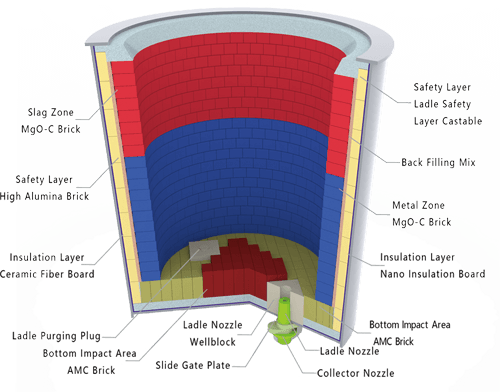
The ladle nozzle is installed before the ladle is baked and put into operation. Sealing putty is applied to the outside of the nozzle, and then the nozzle is manually pressed into the base brick using strong pressure. This ensures that the base brick, putty, and nozzle are tightly connected as a whole, increasing overall strength. A detailed installation diagram is shown in Figure 2. During use, the uppermost part of the base brick directly contacts the initial impact of the molten steel. As the molten steel flows out, it is continuously eroded and washed away, causing the base brick to shorten. The nozzle inside the base brick is the direct channel for the molten steel to flow out, enduring the impact and friction of the high-temperature molten steel and the temperature changes during production. Its connection to the base brick is sealed with the sealing putty.
Between July and September 2019, cracks appeared in the sprue bearing bricks. Those that were discovered in a timely manner were taken offline for treatment. Those that were not discovered in a timely manner were forced to pass steel through the mortar channel between the sprue and the bearing brick. This seriously restricted the on-site production rhythm, increased the cost of steel ladles, and put production in a passive situation.
Regarding the steel leakage accident between the sprue and the nozzle caused by cracked sprue, an analysis and investigation were conducted from multiple aspects, including nozzle quality, composition, sprue quality, and construction. The nozzle was intact and undamaged, so the cause could be ruled out. The cracks found in the sprue were mainly due to the cracks in the sprue, which resulted in incomplete integrity and reduced strength. At the same time, the gap between the sprue and the nozzle increased, allowing molten steel to seep into the gaps in the sealant. The overall strength of the sprue, sealant, and nozzle, which form a unified structure, was compromised. The sealant could not withstand the high temperature of the molten steel and was gradually corroded, resulting in steel spitting and leakage accidents.
Solutions and measures to address steel leakage
Regarding the steel leakage accident caused by cracks in the bearing mortar, the steelmaking plant and technical center personnel, in conjunction with the manufacturer, analyzed the cause. On one hand, they analyzed and adjusted the bearing mortar material from the manufacturer; on the other hand, they urgently sourced products from other domestic bearing mortar manufacturers with good quality and reputation for trial use. The details are as follows:
1) Using base bricks from Manufacturer A on-site, micro-cracks were found after approximately 60 uses, and the upper part of the base bricks showed obvious diameter expansion.
2) Base bricks from Manufacturer B also showed multiple longitudinal micro-cracks, distributed at 90-degree angles in the middle of the base bricks (using the base bricks as a horizontal reference from the ladle hot repair platform, the cracks were not at the four corners).
3) The ladle contractor analyzed the material of the base bricks, selected high-quality raw materials, and gradually refined the formula. They also adjusted the formula and composition of the internal aggregates and powders. Through use and analysis, the probability of cracking gradually decreased. The following measures were taken regarding the installation of the base bricks: The base bricks were laid together with the ladle base during installation. Before positioning the base bricks, impurities were cleaned and filled at the steel structure location at the bottom of the base brick.
The surrounding area was then vibrated and filled with castable refractory. After the overall construction was completed, the base bricks were baked and then put into service. A detailed diagram is shown below.
1) Strictly control the water-cement ratio of the castable refractory around the base bricks of the ladle, maintaining the moisture content between 6-8%.
2) Castable refractory construction: For the gap (30-100mm) between the base bricks and the ladle bottom, manual operation should be used during vibration; vibratory rods should not be used to avoid excessive vibration force and aggregate settling.
3) When replacing the nozzle online, check the base bricks for cracks and erosion.
4) Maintain frequent communication with the dispatcher. If the ladle waiting time exceeds 30 minutes after being taken offline, a second baking should be performed.
5) Strictly monitor the temperature during ladle baking, using a designated logbook to record the temperature of various parts (bottom, wall, slag line, and ladle opening). Closely monitor the venting status at the ladle nozzles and on the ladle wall during baking.
6) The manufacturer, in conjunction with the company’s technical center personnel, should provide a complete on-site ladle construction plan, display it on the wall, and conduct regular training.
The effect after the renovation
Through nearly two months of efforts focusing on several aspects of the refractory lining bricks, the cracks gradually decreased and disappeared, and the service life remained within a controllable range. The direction and effect of the renovation were good, preventing production accidents and saving refractory material costs.
Steel ladles are crucial tools for transferring molten steel in steelmaking. The quality of the internal refractory materials and the quality of construction directly affect the smooth and safe operation of production. The daily management and allocation of ladles require exploration and summarization by technical personnel in each steel plant based on their specific operating conditions. The experience described above is worth learning from and promoting.