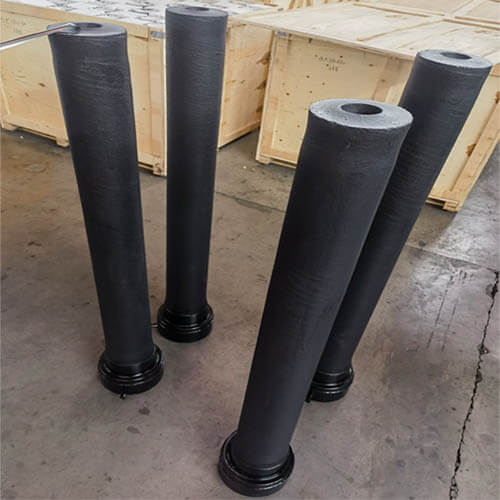
During the continuous casting process, air is easily aspirated through joints between nozzles, leading to the secondary oxidation of molten steel. While argon injection through the long nozzle is employed in production to prevent air aspiration, improper control of the argon flow rate can result in casting defects. Air aspiration occurs because the internal pressure of the nozzle falls below atmospheric pressure; however, current practices lack a link between argon flow rate control and process parameter adjustments. Based on the continuity and Bernoulli equations, a mathematical-physical model of mass and energy conservation for the flow from the ladle to the tundish was established to investigate the internal pressure distribution of the molten steel within the long nozzle. The study characterized fluid distribution patterns under various outlet conditions and argon flow rates, calculated theoretical argon flow rates for different scenarios, and analyzed the effects of casting time, casting speed, diameters of the slide gate and long nozzle, immersion depth, and argon flow rate on internal pressure distribution. The results indicate that increasing the casting speed and immersion depth, reducing the diameters of the slide gate and long nozzle, and increasing the argon flow rate help mitigate negative pressure within the nozzle. Argon flow rates should be increased when casting speed or immersion depth is raised, or when nozzle diameters are enlarged. The use of a trumpet-shaped long nozzle reduces the exit velocity of the molten steel and results in lower internal pressure compared to a straight-bore nozzle; furthermore, the increase in exit velocity during argon injection is smaller for the trumpet-shaped nozzle than for the straight-bore type. These findings provide a theoretical basis for determining argon injection rates for long nozzles.
Inclusions in steel can impair its mechanical properties, machinability, fatigue performance, weldability, and corrosion resistance. The tundish, as a metallurgical vessel before solidification, significantly impacts the quality of subsequent cast billets due to the composition, cleanliness, and superheat of the molten steel within it. The metallurgical function of the tundish is closely related to the flow field of the molten steel. As molten steel flows from the ladle to the tundish to the crystallizer under gravity, its gravitational potential energy is converted into kinetic energy. During this process, a series of flow control devices, such as sliding gate nozzles, ensure a stable flow rate. The pressure distribution of the molten steel significantly affects its flow velocity. Furthermore, when the pressure inside the nozzle is lower than atmospheric pressure, air intake may occur at interfaces, cracks, and refractory material voids. This secondary oxidation of the molten steel is a major cause of inclusions in continuously cast billets.
To improve steel quality and reduce inclusion content, protective casting techniques are employed during continuous casting. Molten steel enters the tundish from the ladle through a long nozzle. Improving the seal of the long nozzle is often used to prevent air intake, but this method cannot fundamentally prevent air intake. Firstly, when using sealing gaskets, issues arise such as deformation, loosening, and damage, creating gaps at the joint between the outlet and the long nozzle. Secondly, during the installation of the long nozzle, since most ladles are heavy machinery, precise control remains difficult despite ongoing research into long nozzle installation and mechanics. Frequent replacements and wear of long nozzles during production make perfect alignment challenging, and gaps at the interface allow for significant air intake. Furthermore, the reaction of alloy precipitation in the molten steel with oxygen in the air to produce deoxidation products, and the dissolution of air in the molten steel, all contribute to negative pressure at the nozzle. Studies have shown that even sub-millimeter gaps in the nozzle sidewall can lead to substantial air intake, causing secondary oxidation of the molten steel. However, by using argon blowing through the long nozzle, the pressure inside the nozzle exceeds atmospheric pressure, reducing air intake and the generation of deoxidation products. Meanwhile, argon gas forms an argon film on the nozzle wall, preventing deoxidation products from depositing and enhancing turbulence in the molten steel. Studies have shown that argon blowing through long nozzles promotes the flotation of inclusions in the tundish; however, excessive argon flow can cause severe fluctuations in the tundish liquid level, leading to slag entrapment or exposed molten steel, affecting steel quality. Research indicates that the lowest pressure zone within the long nozzle is below the slide plate plane, and a larger opening results in lower pressure loss; however, the effects of ladle level, long nozzle immersion depth, and nozzle shape on the internal pressure and argon flow rate are rarely studied.
Furthermore, the shape of the long nozzle significantly impacts the flow field within the tundish. Using a straight-cylinder long nozzle prevents submerged casting, easily causing steel oxidation and slag entrapment; a flared long nozzle improves molten steel backflow and splashing, enabling submerged casting and improving molten steel cleanliness. However, the effect of the long nozzle shape on the argon flow rate has not been studied.
YANG H et al. studied the pressure distribution within the nozzle section from the tundish to the crystallizer, analyzing the relationship between the nozzle pressure and the nozzle diameter, nozzle immersion depth, and tundish liquid level, and estimating the effect of air intake rate on alumina inclusion formation. Their main focus was on nozzle blockage caused by air intake in submerged nozzles, without providing recommended argon blowing flow rates.
Long nozzles can prevent air intake at the nozzle joints. Currently, argon blowing flow rates vary depending on the production line, and research on nozzle argon blowing flow rates is scarce and primarily focused on automatic control. Furthermore, the influencing factors of argon blowing variation are not well-documented. Therefore, establishing a nozzle pressure model to determine a reasonable argon blowing flow rate is essential. This study uses Bernoulli’s equation and continuity equation to establish a mass-energy model from the ladle to the tundish, exploring the pressure loss within the nozzle and investigating the effects of casting time, billet pulling speed, nozzle diameter, argon blowing flow rate, and nozzle shape on the pressure distribution within the nozzle. This provides a theoretical basis for controlling the argon blowing rate and offers reference for the production of high-quality steel and reducing consumption.
Conclusion
1) In industrial long nozzles, when there is poor sealing or during purging, gas is distributed in the form of bubbles within the nozzle, and the gas-molten steel mixture can completely fill the nozzle.
2) During steady-state casting, the ladle molten steel level has little effect on the pressure distribution within the long nozzle, and the theoretical minimum argon flow rate does not change over time.
3) Negative pressure exists at the lower nozzle and the upper part of the long nozzle. Increasing the casting speed helps reduce the negative pressure within the nozzle, but increases the theoretical argon flow rate. Increasing the immersion depth of the long nozzle and decreasing the nozzle diameter help reduce both the negative pressure and the theoretical argon flow rate, with decreasing the nozzle diameter having the most significant impact on the negative pressure.
4) Increased argon flow rate leads to increased nozzle outlet velocity. Using a flared long nozzle reduces the fluid velocity at the outlet, resulting in a smaller velocity increase when argon is introduced compared to a straight-tube nozzle. The internal pressure of a flared nozzle is lower than that of a straight-tube long nozzle; doubling the outlet diameter of the long nozzle increases the argon flow rate by approximately 2.5 times.