
The fundamental principle of the AOD (Argon Oxygen Decarburization) process is to reduce the partial pressure of CO through gas dilution. The injection of a high-pressure argon-oxygen gas mixture increases the contact between the molten steel, gas bubbles, and slag, which facilitates the rapid removal of carbon, sulfur, and non-metallic inclusions. During the smelting process, the composition and properties of the slag in an AOD furnace undergo significant changes—with basicity shifting from approximately 0.6 in the initial stages to 4.0–4.5 in the later stages—exposing the refractory lining to corrosive environments ranging from highly acidic to basic slag. The primary causes of refractory degradation include: intense turbulence and erosion of the molten steel and slag driven by gas-induced vortexes; high refining temperatures (1700–1750°C) and significant temperature fluctuations, which lead to thermal spalling and structural spalling; and the penetration and dissolution of the furnace lining caused by slag with highly variable basicity at elevated temperatures. Consequently, refractories used in AOD furnaces must possess high-temperature strength, as well as excellent resistance to thermal shock, slag corrosion, and erosion-abrasion.
The lining of an AOD (Argon Oxygen Decarburization) furnace is typically constructed using direct-bonded, rebonded, or semi-rebonded MgO-Cr2O3 bricks. Direct-bonded MgO-Cr2O3 bricks are produced by firing high-quality, high-purity magnesia and refined chrome ore at high temperatures; their microstructure is characterized by direct bonding between the primary crystalline phases, with low-melting-point silicate phases existing in isolation. Rebonded MgO-Cr2O3 bricks are manufactured by crushing fused magnesia-chrome clinker and subsequently firing it at high temperatures; they offer excellent slag resistance and perform better in service than direct-bonded MgO-Cr2O3 bricks. Semi-rebonded MgO-Cr2O3 bricks combine the characteristics of both direct-bonded and rebonded MgO-Cr2O3 bricks, offering even superior performance.
The degradation of magnesia-chrome bricks used in AOD (Argon Oxygen Decarburization) furnaces is primarily attributed to structural spalling, which results from slag penetration and the subsequent alteration of the brick matrix. To enhance their performance, the production of magnesia-chrome bricks should take the following factors into account:
(1) Strict control of chemical composition. An optimal Cr₂O₃ content (expressed as a mass fraction, as is the case for all subsequent percentages) is 18%–20%. Since SiO₂ content has the most significant impact on corrosion resistance, it should be kept as low as possible—ideally below 1%. Additionally, the CaO content must be strictly controlled.
(2) During the brick-manufacturing process, the particle size distribution should be carefully managed, and the bricks should be subjected to high-pressure forming and ultra-high-temperature firing.
Magnesia-calcia series refractories
Magnesia-calcium refractories have garnered significant attention due to the abundance and low cost of their raw materials; however, their susceptibility to hydration—among other drawbacks—has limited their widespread application. The primary types of refractories used for AOD furnace linings are fired magnesia-dolomite bricks and unfired (chemically bonded) fused magnesia-dolomite bricks. Fired magnesia-dolomite bricks are produced using high-quality sintered magnesia-dolomite clinker as the main raw material, which is shaped under high pressure and then fired at temperatures exceeding 1600°C. Unfired fused magnesia-dolomite bricks are manufactured using fused magnesia-dolomite clinker, which is shaped under high pressure and subsequently dried at a low temperature. Because the fused magnesia-dolomite clinker undergoes thorough melting, resulting in a well-developed crystal lattice and lower chemical reactivity, these fused magnesia-dolomite bricks exhibit superior resistance to both corrosion and hydration.
Selection of Refractory Materials for AOD Furnaces
Magnesia-chrome and magnesia-calcia refractories are the primary types used in AOD (Argon Oxygen Decarburization) furnaces. As shown in Table 3, which details the service life of AOD furnace linings made from these various materials, each type has its own distinct advantages and limitations. Overall, however, magnesia-calcia refractories offer greater advantages, and their application in AOD refining furnaces has become a clear trend.
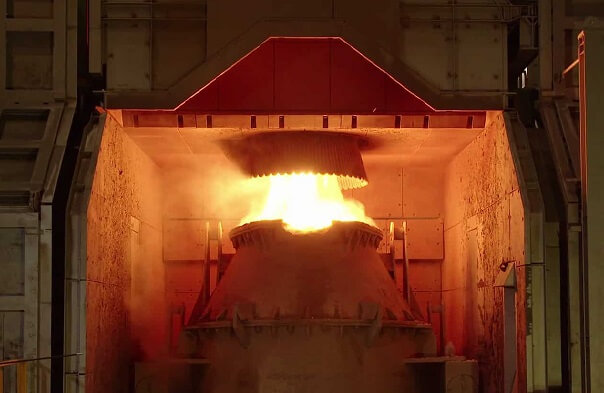
When selecting refractory materials for an AOD furnace, the following criteria must be met:
- Regarding thermal stability, the material must be able to withstand sudden, high-temperature thermal shocks, demonstrating excellent heat resistance and thermal durability. It must ensure that no significant thermal spalling or thermal bursting occurs during wide-ranging temperature fluctuations.
- Regarding corrosion resistance, the material must be capable of enduring the erosive effects of various high-temperature chemical substances present within the furnace, while maintaining robust thermochemical stability even amidst substantial variations in alkalinity.
- Regarding mechanical properties, the material must possess superior mechanical shock resistance and wear resistance to withstand the frequent impact and abrasion caused by the turbulent, swirling mixture of molten steel and slag.
In the United States—where magnesia-chrome bricks have traditionally served as the primary furnace lining material—there has been an increasing focus in recent years on the development of magnesia-calcia-based refractories. This is due to the unique advantages offered by this class of materials:
(1) Its primary components, MgO and CaO, possess high melting points (2800°C and 2570°C, respectively), low vapor pressures, and stable thermodynamic properties.
(2) The dihedral angle of MgO-CaO bonds is larger than that of MgO-MgO bonds, which helps enhance resistance to slag penetration and slag erosion. Furthermore, MgO-CaO-based materials exhibit superior thermal shock resistance compared to MgO-Cr₂O₃-based materials.
(3) The presence of CaO facilitates the purification of molten steel, making these materials particularly well-suited for the production of clean steel.
(4) The raw materials are abundant and inexpensive, and their use avoids the environmental hazards associated with chromium.