
Basic oxygen furnace (BOF) steelmaking is a core process in modern iron and steel production. Refractory materials and lining auxiliaries serve as the primary barrier for the furnace vessel, directly determining furnace service life, production efficiency, operational safety, and overall costs. This article systematically outlines the core performance requirements for refractories, the characteristics of mainstream materials, and selection specifications for critical furnace zones, based on the operating conditions across the entire BOF steelmaking process, thereby providing a professional reference for industrial production and technical selection.
Core Performance Requirements for Refractory Materials in Iron and Steel Smelting Operations
During the converter steelmaking process, refractory materials operate under extreme, combined conditions—including high temperatures, intense chemical erosion, cyclic mechanical loads, and rapid thermal cycling. To ensure stable service, they must simultaneously meet the following seven core performance requirements:
- High-temperature stability across a wide temperature range: Refractories must possess a refractoriness of ≥1760°C, remaining stable throughout the entire smelting process without softening, melting, or deforming.
- Excellent thermal shock resistance: They must withstand frequent, rapid temperature fluctuations during smelting, inhibiting crack initiation, propagation, and structural failure caused by thermal stress, thereby maintaining the structural integrity of the furnace lining.
- Mechanical load-bearing capacity across a wide temperature range: They must maintain stable compressive strength under all operating conditions—from room temperature to high heat—withstanding continuous cyclic compressive stress without structural failure.
- High resistance to erosion and abrasion: They must withstand the continuous friction and erosion caused by falling furnace charges and the high-speed flow of molten steel and slag, minimizing the rate of mechanical wear.
- Resistance to slag erosion across various slag systems: They must exhibit excellent chemical erosion resistance, withstanding penetration, dissolution, and chemical reactions from acidic, basic, and other slag systems, thereby inhibiting melting loss and degradation of the lining.
- High resistance to deformation under load: They must withstand the immense static pressure, hydrodynamic pressure, and buoyancy exerted by molten steel, ensuring no risk of structural deformation or collapse during long-term service.
- Strong resistance to furnace gas penetration and reaction: They must resist the penetration and chemical effects of furnace gas components (such as CO, SO₂, CO₂, CH₄, and H₂O) as well as volatile oxides and salts from the molten steel, preventing internal structural degradation and performance deterioration.
Based on these core requirements, refractory materials serve primarily as a highly efficient thermal barrier within the converter system, while also offering the flexibility to incorporate additional functions—such as thermal conductivity or heat storage—tailored to specific application needs.
Specification for Converter Lining Structural Systems and Brick Selection
Modern converter linings feature a multi-layer composite design, comprising—from the inside out—a working layer, a permanent layer, and an insulation layer; refractory materials with properties tailored to each specific layer are utilized.
- Insulation Layer: Its primary function is to minimize heat loss from the furnace shell. It is typically constructed using polycrystalline refractory fibers; however, the insulation layer in the furnace hood area may also be formed by ramming resin-bonded magnesia, a method suited to the construction requirements of complex, irregular shapes.
- Permanent Layer: Serving as a safety backup for the lining, this layer utilizes different types of bricks depending on the specific furnace section. It is generally constructed using lower-grade magnesia-carbon bricks, tar-bonded dolomite bricks, or sintered magnesia bricks, ensuring the overall structural stability of the lining.
- Working Layer: This layer is in direct contact with molten steel, slag, and high-temperature furnace gases, making it the critical zone for the lining’s service life. It is constructed entirely of magnesia-carbon bricks, with specific grades selected to match the varying operating conditions of different furnace sections.
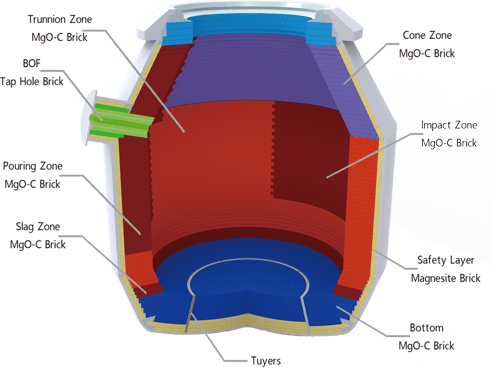
Performance Requirements and Selection of Specialized Refractories for Critical Areas of Basic Oxygen Furnaces
The converter taphole and bottom gas-supply elements are critical components subject to the most severe operating conditions and rapid degradation during the smelting process; therefore, the selection of bricks for these areas must be tailored to specific conditions to achieve an optimal balance between performance and service life.
(I) Taphole Bricks
Throughout the smelting process, the taphole is subjected to high-speed erosion by molten steel at high temperatures, rapid thermal cycling during tapping and plugging operations, and chemical attack by slag, making it one of the areas of the converter lining most prone to severe damage.
To withstand these conditions, the taphole requires lining with monolithic or composite magnesia-carbon bricks characterized by high erosion resistance, strong oxidation resistance, and high structural stability. High-grade products, such as MT-14A, are preferred in industrial production. The typical service life is approximately 200 heats; timely replacement upon reaching the end of this cycle is essential to prevent safety hazards such as aperture enlargement or steel breakouts.
(II) Bottom Gas-Supply Bricks
Bottom gas-supply bricks are core components of the converter combined-blowing process, used to inject gases—such as Ar, N₂, CO₂, or mixtures with oxygen—into the furnace from the bottom to ensure uniform stirring of the molten bath. During operation, these bricks endure extreme conditions, including high temperatures, intense bath agitation, and high-speed erosion by molten steel and slag, while simultaneously meeting the gas-supply requirements of the combined-blowing process.
Consequently, bottom gas-supply bricks must meet the following core requirements:
- Possess excellent resistance to high temperatures, slag corrosion, molten steel erosion, mechanical wear, and thermal shock spalling;
- Enable uniform and stable gas supply, generating fine, evenly distributed bubbles to ensure effective metallurgical results from combined blowing;
- Feature a safe and reliable structure, with a service life synchronized as closely as possible with that of the overall converter lining to minimize the need for mid-campaign maintenance or replacement.
The performance matching, selection specifications, and quality control of refractory materials used in converter steelmaking are critical factors determining production stability, lining service life, and overall manufacturing costs. As basic oxygen furnace (BOF) steelmaking evolves toward higher efficiency, lower energy consumption, and extended furnace service life, the technological iteration and precise selection of refractory materials will continue to be a key focus of technological upgrading in the iron and steel industry.