
The selection of refractory materials for medium-frequency furnaces directly impacts operational safety, melting efficiency, and production costs. It requires comprehensive consideration of various factors, such as the melting process, material properties, and operating conditions. The specific selection criteria are as follows:
1.Suitability based on the type and characteristics of the metal being melted
Melting environments for different metals and alloys place significantly varying demands on the chemical stability and corrosion resistance of refractory materials; this serves as the primary basis for selection:
Melting environments for different metals and alloys impose significantly different requirements regarding the chemical stability and erosion resistance of refractory materials; these requirements serve as the primary basis for material selection:
- Melting point of the metal:
For low-melting-point metals (e.g., gray iron and ductile iron, with melting points around 1200–1500°C), acidic materials with moderate refractoriness (such as those based on silica sand) are suitable. For high-melting-point metals (e.g., alloy steel and stainless steel, with melting points exceeding 1500–1700°C), neutral (corundum-based) or basic (magnesia-based) materials with high refractoriness must be selected to prevent material softening and failure. - Chemical properties of the metal and slag:
◦ When melting produces acidic slag (e.g., slag with high SiO₂ content during cast iron melting), acidic refractory materials are preferred; this utilizes the principle of “acid-acid compatibility” to minimize chemical erosion.
◦ When melting produces basic slag (e.g., slag with high CaO or MgO content during the melting of high-manganese steel or high-alloy steel), basic or neutral refractory materials must be used to prevent rapid corrosion of acidic materials by the basic slag.
◦ When melting high-purity metals or alloys (e.g., titanium alloys or superalloys), neutral materials with exceptional chemical stability (such as corundum-spinel-based materials) are required to avoid interfacial reactions between the refractory material and the metal that could contaminate the melt.
2.Compliance requirements for key performance indicators of refractory materials
Particular attention must be paid to the material’s high-temperature performance to ensure it meets the rigorous operating conditions of medium-frequency furnaces.
- Refractoriness: Must exceed the maximum melting temperature by at least 50–100°C. For example, when melting molten steel (max. 1700°C), the refractory material requires a refractoriness of ≥1750°C; for molten iron (max. 1500°C), it requires ≥1550°C to prevent material softening or melting at high temperatures.
- Thermal Shock Resistance: Frequent heating and cooling cycles in medium-frequency furnaces (such as the charging-to-tapping cycle in batch melting) generate severe thermal stress, necessitating materials with good thermal shock resistance. This is typically measured by the number of “water-cooling/rapid-heating cycles” a material can withstand; high-quality neutral or spinel materials should endure ≥30 cycles (without cracking during water cooling from 800°C), while acidic materials require ≥20 cycles.
- High-Temperature Strength: Refractory materials must maintain structural stability under the influence of molten metal hydrostatic pressure and electromagnetic stirring forces. Compressive strength at room temperature should be ≥50 MPa, and at 1400°C, it should be ≥20 MPa (≥25 MPa for basic materials) to prevent lining deformation or collapse.
- Volumetric Stability: No significant shrinkage or expansion at high temperatures (linear change rate ≤±1%). For acidic materials, attention must be paid to the crystalline transformation of quartz (which causes sudden volume changes at 573°C and 846°C); this requires improvement through the addition of mineralizers. For basic materials, sintering shrinkage must be controlled to prevent cracking.
- Low Thermal Conductivity and Electrical Insulation: Thermal conductivity should be ≤2 W/(m·K) at 1000°C to minimize heat loss; volume resistivity should be ≥10⁸ Ω·cm at room temperature to prevent induction current leakage. Additionally, the material must be free from metallic impurities or conductive particles.
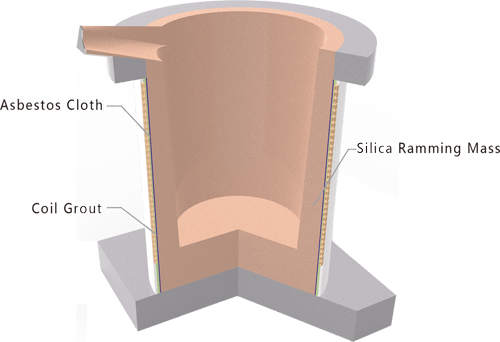
3.Compatibility of Medium-Frequency Furnace Operating Conditions
Materials must be selected based on a combination of equipment parameters and process characteristics:
Material selection must be based on equipment specifications and process characteristics:
- Furnace specifications and power:
◦ Small medium-frequency furnaces (capacity < 1 ton, power < 500 kW) operate at lower frequencies and experience minimal thermal shock; cost-effective acidic materials are suitable.
◦ Large medium-frequency furnaces (capacity ≥ 5 tons, power ≥ 1000 kW) or continuous melting furnaces involve high temperatures, prolonged operation, and significant thermal stress; high-strength, highly stable neutral or spinel-based materials are required. - Melting process characteristics:
◦ Batch melting (frequent start-stop cycles) places higher demands on thermal shock resistance; spinel or modified corundum materials are preferred.
◦ Continuous melting (sustained high temperatures) prioritizes high-temperature strength and erosion resistance; basic or high-purity neutral materials are more suitable.
◦ Rapid heating processes (heating rate > 100°C/min) require materials with uniform thermal expansion to prevent cracking caused by localized temperature gradients. - Furnace atmosphere:
◦ Oxidizing atmospheres (e.g., melting ordinary carbon steel) impose fewer constraints on material selection.
◦ Reducing atmospheres (e.g., melting high-carbon alloys) require avoiding materials susceptible to reduction (such as low-quality refractories containing Fe₂O₃).
◦ Humid environments require moisture-resistant materials (e.g., pre-calcined magnesia-based basic materials) to prevent disintegration caused by moisture absorption.
4.Balancing Cost-Effectiveness and Practicality
While meeting performance requirements, it is necessary to comprehensively consider both cost and ease of use:
- Service life and total cost: Avoid prioritizing low initial prices; instead, calculate the “cost per furnace heat.” For instance, although basic materials have a higher initial cost than acidic materials, their service life is three to five times longer, making them more economical in the long run. For large furnaces, selecting long-lasting materials reduces the frequency of shutdowns for maintenance and boosts production efficiency.
- Ease of installation and maintenance: Acidic materials (such as dry-ramming quartz sand) are easy to install and require no complex pre-treatment. In contrast, neutral or basic materials demand higher standards for ramming density and drying-out schedules, requiring professional installation techniques; improper installation can easily shorten their service life.
- Supply stability: Prioritize materials with stable quality and ample market availability to avoid production disruptions caused by shortages of niche materials. Additionally, consider the supplier’s technical support capabilities (such as the provision of drying-out curves and installation guidance).
5.Specific Requirements for Specialized Applications
- Melting Special Alloys: Melting high-manganese steel requires basic materials highly resistant to MnO erosion, whereas melting stainless steel requires corundum-spinel materials resistant to Cr₂O₃ and NiO erosion.
- Environmental Protection and Safety: Select refractory materials that generate minimal dust and contain low levels of hazardous components (such as acidic materials free of free SiO₂) to minimize health risks to operators; additionally, the materials must possess good electrical insulation properties to prevent the risk of electric leakage.
In summary, the selection of refractory materials for medium-frequency furnaces should adhere to the principles of performance suitability, process compatibility, and economic practicality. The core approach involves prioritizing key performance metrics—such as refractoriness, thermal shock resistance, and erosion resistance—based on the type of metal being melted, furnace specifications, and operating conditions. Subsequently, one must balance costs and installation complexity to ultimately achieve the goals of extending furnace lining service life and reducing production costs.