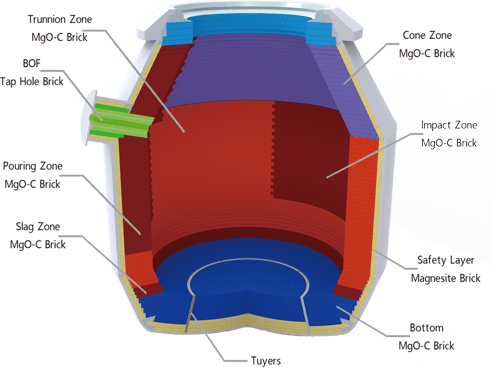
The steel plant currently has two 200-ton vanadium extraction converters and two 200-ton steelmaking converters. All four converters use the same construction method and feature integral tapholes with a lifespan ranging from 80 to 120 taphole cycles. Since commissioning, the steelmaking converters have frequently experienced taphole penetration (or leakage) accidents, occurring 5-7 times per year. Each taphole penetration requires immediate shutdown, disrupting normal production operations.
When the taphole bricks are partially damaged, molten steel penetrates the bricks and reaches the furnace shell area, causing the furnace shell steel plate at the flange-to-shell connection to melt and leak, resulting in slag and steel spillage. After penetration, a large amount of lime is added to the remaining molten steel to adjust the slag, and then the remaining molten steel is poured from the large taphole into the ladle to prevent large-scale furnace shell burn-out. Because there are no slag-blocking measures at the large taphole, slag and steel are discharged together, leading to severe phosphorus return in the slag and a high risk of high phosphorus content in the finished product and burnt-out tapholes. After steel leakage occurred at the taphole of the converter, inspection of the taphole channel revealed significant melting damage to the taphole bricks. Partial cracking of the refractory bricks at the taphole allowed molten steel to leak through the cracks, resulting in steel leakage. The number of taphole leakage incidents ranged from 49 to 105.
Analysis of the reasons for steel penetration
1.1 Taper Angle
The taper angle of a converter is typically designed to be between 0° and 15°. Most steel mills in China use a 0° taper design, while the Xichang 200-ton converter uses a 10° taper. This 10° angle design helps shorten the ladle car’s travel distance during tapping, improving efficiency. However, during tapping, the molten steel cannot fall freely vertically; it moves at an angle within the 10° channel, experiencing a force towards the rear of the furnace. This significantly increases friction and stress on the taper. The vortices formed by the rotating steel flow during tapping exacerbate refractory erosion, easily leading to pitting within the taper channel. The taper angle design is difficult to improve, and other measures are needed to compensate for this deficiency.
1.2 Bedding Brick Damage
The bedding bricks near the furnace interior exhibit a thinner-than-thicker refractory thickness, making the inner part of the converter a weak point. As the number of smelting furnace cycles increases, the refractory material of the converter body is gradually eroded, and the erosion of the large surface area after the converter causes the thickness of the bedding bricks to gradually decrease. In the middle and late stages of the converter’s service life, due to long-term erosion by molten steel, the thinnest part of the refractory material on the large surface area after the converter is only 300-400mm thick. At this time, the thickness of the bedding bricks inside the taphole is only about 100mm. When subjected to the impact of taphole replacement, the bedding bricks are prone to cracking, and their erosion resistance decreases. To achieve a longer furnace life, methods such as slag splashing, slag coating, and spraying are used to increase the thickness of the taphole and the large surface area back to 700-800mm. At this time, the bedding bricks at the converter taphole are a bonded slag splash layer and a repair material filling layer, and their erosion resistance is significantly lower than that of the bedding bricks. Damage to the bedding bricks is the root cause of steel penetration at the taphole. Damaged taphole bedding bricks are incomplete in shape and have internal cracks, posing a high risk of damage. When maintenance is inadequate, high-temperature molten steel seeps outward from the gaps in the refractory bricks. When this seeps into the molten steel and reacts with the magnesia-carbon bricks in the gaps, the erosion rate accelerates, causing the refractory bricks to become loose, perforated, and damaged.
1.3 Void Water Hammer Effect
During tapping, air bubbles adsorbed on the rough refractory surface rise to the surface. This causes molten steel to fill the areas opposite to where the bubbles have risen, creating an impact that erodes the refractory material. This phenomenon is called void water hammer. The water hammer effect of molten steel has a significant impact on steel penetration at the tapping spout. Once steel penetration occurs at the tapping spout, the refractory bricks are essentially damaged, and the risk of further penetration increases significantly.
From the dissection of the tapping spout area after furnace dismantling, a void penetration channel has formed between the flange connection to the furnace shell and the tapping channel. After the steel tapping hole is re-bored and filled with binding material, it is compacted with sprayed refractory material, and finally moistened with sprayed slurry to form a dense binding layer in the previously leaked tapping channel. However, this binding layer is not as dense as that of magnesia-carbon bricks, and the base bricks are still riddled with holes. When the furnace lining bricks inside the tapping hole are not properly maintained, or when gaps appear between the tapping hole and the base bricks, the water hammer effect in these gaps is significant, making it very easy for steel leakage to occur again.
1.4 Spraying Process and Repair Material Quality
After the tapping hole is replaced, the gaps between the furnace lining bricks, the outer base bricks of the tapping hole, and the tapping hole casing bricks need to be filled with repair material. Refractory material and water are mixed and sprayed through a spray gun to fill the gaps. The spraying process, such as the consistency and spray angle, has a significant impact on the density of the gap filling, thus significantly affecting the number of times the tapping hole can be used.
The repair material used for filling gaps undergoes boiling and evaporation of water in the residual temperature of the steelmaking converter (around 1000℃), followed by sintering over a period of time to form a dense sintered layer that meets the needs of steel smelting and scouring. The MgO content in the refractory material and the scouring resistance of the sintered material, among other quality indicators, significantly affect the number of times the taphole can be used.
Improvement measures
2.1 Improvement of Post-Converter Liner Maintenance Process
Erosion of the post-converter lining can damage the lining bricks, weakening the refractory’s resistance to erosion. After the post-converter lining is thinned, the refractory material thickened through slag splashing, slag coating, and spraying has weak erosion resistance. Exposure to high-temperature oxidation furnace cycles will exacerbate damage and lead to steel leakage. Therefore, to prevent lining brick damage, the thickness of the post-converter lining must be strictly controlled. To control the degree of erosion, the converter charging volume is controlled within the range of 215±5t, and the scrap steel amount is controlled at 35kg/t. Infrared slag detection is used to prevent slag splashing when steel is not fully tapped, which would cause erosion of the furnace lining by molten steel.
2.2 Improvement of Liner Brick Quality
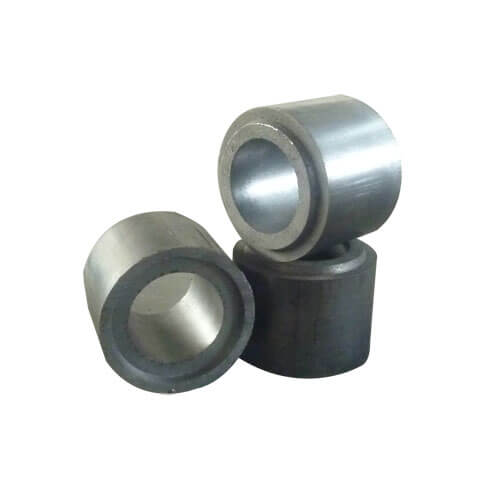
The quality of the taphole lining bricks directly affects the use of the converter taphole. Taphole lining bricks made of 98% magnesia were selected, and in actual use, it was found that their erosion resistance was enhanced.
2.3 Improvement of Tunnel Quality
A modular, assembled tunnel casing is selected. During manufacturing, the modular tunnel casing undergoes mechanical compaction, resulting in a higher refractory density compared to a monolithic casing. Cracked casings should not be used, as this increases the likelihood of steel leakage. The number of times the tunnel is used should be controlled (≤120 times). When the tunnel is nearing the end of its service life, it should be replaced promptly to prevent localized thinning that could lead to steel penetration.
2.4 Improvement of Spray Irrigation Process
Each boring operation causes the boring head to vibrate and impact the tunnel casing, further damaging the already compromised casing. If the grout used after boring is too thick, it is difficult for the grout to flow back into the damaged casing and gaps, resulting in steel trapping at the tunnel. Therefore, after boring, a thinner slurry should be sprayed to fully fill the voids, ensuring a sintering time of more than 15 minutes. This allows the refractory material to fully solidify and dry, forming a dense, bonded refractory layer.
Daily inspection and maintenance of the taphole are crucial for preventing steel penetration. After tapping, observe the furnace interior of the taphole. Ideally, the distance between the top of the refractory material and the slag splash layer should be 30-50 mm; it should not exceed the slag splash layer. If the furnace interior portion of the taphole is exposed, it must be repaired.
2.5 Improvement of Refractory Material Quality
Improving the quality of the refractory material used for taphole repair is also an important measure to reduce steel leakage at the converter taphole. Currently, a repair material with 80% MgO content is used. To reduce steel penetration, a taphole repair material with 90% MgO content is used, and phosphate is used instead of water glass as the binder. In comparison, the repair material with 90% MgO content showed significantly better erosion resistance than the currently used repair material (80% MgO content). After its implementation, the number of maintenance heats at the converter tapping spout decreased from three per shift to one per shift.
Furthermore, it is crucial to control the temperature and oxidizing properties of the molten steel. Over-oxidation of the molten steel and high temperatures should be avoided to prevent severe corrosion of the refractory materials. Xichang Steel & Vanadium Plant, through optimizing the converter reblowing process, dynamic heat balance control, and optimizing ladle baking, reduced the tapping temperature from an average of 1678℃ in 2013 to 1654℃ in 2017. Under the same carbon content level, the oxygen content at tapping decreased by 100 ppm, which also played a positive role in improving the corrosion resistance of the refractory materials.
Results achieved
By improving the post-converter spraying process, the converter tapping spout was changed from an integral type to a segmented combination type. At the same time, a series of measures were taken, such as increasing the tapping spout seat bricks, increasing the percentage content of MgO in the repair material, and strengthening daily inspection and maintenance. These measures, combined with reducing the oxygen activity of the molten steel at the converter endpoint, lowered the converter tapping temperature. The rear face of the converter was stably controlled between 900 and 1000 mm. The number of times the steelmaking converter’s tapping spout leaked steel was reduced from 5 to 7 times/year to 0 to 1 time/year, and the lifespan of the converter’s tapping spout was stabilized at around 118 times, which greatly improved the smelting efficiency of the converter.
Conclusion
(1) The main causes of steel penetration at the converter taphole are the design of the taphole angle, damage to the bedding bricks caused by erosion of the rear surface, and unreasonable post-boring spraying process.
(2) By strengthening the maintenance of the rear surface of the converter, standardizing the post-boring spraying process, and improving the refractoriness of the bedding bricks and repair materials, the erosion resistance of the refractory materials can be effectively improved, thus effectively controlling the number of times steel penetrates at the taphole.