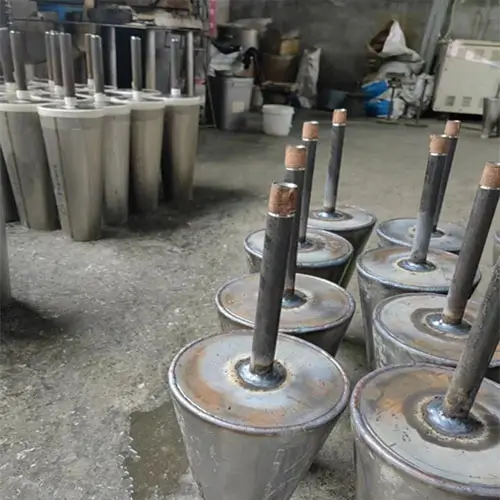
Argon blowing typically involves placing one or more permeable bricks at the bottom of a casting ladle or a brick-built ladle. After tapping, argon gas is blown through these permeable bricks, causing agitation of the molten steel. Argon blowing promotes the flotation of emulsified slag droplets and inclusions in the steel, and can partially remove dissolved gases and homogenize the steel. In conjunction with continuous casting, ladle argon blowing can also regulate the temperature of the molten steel. Ladle argon blowing is an important steelmaking process, and permeable bricks are a crucial functional component of this process.
Types and structures of steel ladle permeable bricks
Based on the gas channel form, permeable bricks can be mainly classified into three types: diffused type, straight-through directional type, and slotted directional type. Diffuse type bricks have small, interconnected pores, high porosity, low density and strength, and poor durability. Straight-through directional type bricks are made by embedding a varying number of thin steel tubes within the brick; some also use special pore-forming techniques without these tubes. The pore diameter is generally between 0.6mm and 1.0mm. Straight-through directional permeable bricks offer reasonable gas flow and distribution, good bottom-blowing effect, and long service life, but are prone to clogging later, affecting the blowing rate. Slotted directional permeable bricks are integrally formed with the inlay material during the molding process. During high-temperature firing, the inlay material melts and volatilizes, forming slots through which gas enters the molten ladle pool. A suitable slot width ensures sufficient bottom-blowing argon intensity, controls and regulates the flow rate, and prevents the risk of permeation and clogging. The slot width of the LF-VD refining ladle permeable bricks in Maanshan Iron & Steel’s No. 1 Steel Rolling Mill is selected to be around 0.18mm, which effectively meets the production requirements of refining.
Based on the installation method, permeable bricks are divided into integral permeable bricks and externally mounted permeable bricks. Integral permeable bricks have a high safety factor, long service life, and are easy to install; however, replacement is difficult. Integral permeable bricks are suitable for process conditions with low argon blowing time and where the life of the permeable bricks can be synchronized with the life of the ladle. Externally mounted permeable bricks are easy to replace, but due to the accompanying installation equipment, their structure is relatively complex, and the on-site installation quality of the brick core is required to be high, which can easily lead to human error accidents. Externally mounted permeable bricks, because they allow for quick replacement of the brick core, are beneficial to the turnover and lifespan of the ladle, and are suitable for process conditions with long argon blowing time and frequent permeable brick replacement, especially in refining ladles. Currently, slotted directional permeable bricks are widely used in ladles.
Material and performance of steel ladle permeable bricks
The main materials used in permeable bricks are sintered magnesia, magnesia-chromium, high-alumina, and corundum. Data shows that under high temperature and vacuum conditions, the stability order of several refractory oxides is as follows: Al₂O₃ > CaO > MgO > Cr₂O₃, and the wetting angle of molten steel is as follows: Cr₂O₃ > Al₂O₃ > MgO. Considering these two points, using corundum as the main crystalline phase of permeable bricks is a better choice. Furthermore, Cr₂O₃ has a melting point of 2275℃, higher than that of Al₂O₃ (2050℃). Alumina and chromium oxide can form a continuous solid solution, and the solid solution formed by Al₂O₃ and Cr₂O₃ significantly enhances the resistance to corrosion by iron oxide or slag. Adding a small amount of Cr₂O₃ can inhibit excessive alumina crystal growth, thereby reducing internal crystal stress and improving the material’s physical properties. However, if too much Cr₂O₃ is added, the growth rate of corundum grains is severely affected, thus reducing the material’s physical properties. Therefore, introducing an appropriate amount of Cr2O3 can improve the thermal shock resistance, erosion resistance, and corrosion resistance of materials.
For argon blowing processes to be successful, permeable bricks must possess good high-temperature resistance, corrosion resistance, thermal shock resistance, high-temperature volume stability, high strength, stable operation, good permeability, accurate dimensions, and low molten steel penetration.
Many researchers have also studied and experimented with non-oxide-bonded corundum permeable bricks. Non-oxides have advantages such as high high-temperature strength, good thermal shock resistance, and difficulty in being wetted by molten metal and slag, such as Si3N4 and β-SiAION. In actual field use, it has been found that non-oxide-bonded corundum permeable bricks have good thermal shock resistance, are non-wetting to molten steel, have high blowing efficiency, are easy to clean with oxygen, have low corrosion rates, and significantly improved service life.
Selection of installation location for breathable bricks
The location of the bottom blowing element in the ladle should be determined based on the purpose of the ladle treatment. The effect of blowing air onto the molten steel differs depending on whether the permeable brick is installed at the center of the ladle bottom or off-center (with the blowing point at 1/2-1/3 of the radius from the center). Center-blowing argon is beneficial for the reaction between the ladle slag and metal, and for the desulfurization reaction of the top slag; while eccentric bottom blowing argon is beneficial for mixing inside the ladle, temperature homogenization, and the floating of inclusions.
Process requirements for the use of breathable bricks
(1) Good permeability. Permeability is one of the important parameters for evaluating the quality of permeable bricks. Studies have shown that the stirring energy of molten steel is directly proportional to the flow rate of the blown gas; the stirring energy directly affects the stirring efficiency of molten steel, and only sufficient stirring energy can achieve a good stirring effect. When the argon blowing volume is constant, the more argon bubbles blown out, the more beneficial it is for the degassing and stirring of the molten steel.
(2) High-temperature corrosion resistance. Refining ladles have very strict requirements in terms of temperature and time, with the highest temperature often reaching above 1750℃ and the refining time sometimes reaching tens of minutes. During the refining operation, the basicity of the slag has a significant impact on the lifespan of the permeable bricks. Therefore, the permeable bricks are subject to corrosion by highly permeable alkaline slag at high temperatures, resulting in rapid damage.
(3) High-temperature wear resistance. During bottom argon blowing in refining ladles, the flow rate of molten steel in the ladle is very fast due to the bottom argon blowing, significantly increasing the scouring and wear of the molten steel on the furnace lining material, bottom permeable bricks, and seat bricks. During hot repairs of the ladle, to remove residual steel and slag from the surface of the permeable bricks and restore their permeability, oxygen blowing is required to clean the surface of the permeable bricks, melting the steel slag adhering to the surface. Simultaneously, molten gas is blown into the permeable bricks to remove the slag. During this cleaning process, the permeable bricks are subjected to the scouring effect of high-speed airflow, therefore, the permeable bricks must possess good high-temperature wear resistance.
(4) Good thermal shock resistance. Due to the intermittent operation of the ladle, when molten steel is poured into the ladle, the ends of the permeable bricks are subjected to the high-temperature molten steel, causing a sudden temperature rise. When argon gas is blown in, they are cooled by the cold airflow, generating significant thermal stress within the material. Simultaneously, the injection of molten steel into the empty ladle also causes significant temperature changes. Therefore, the operating conditions for permeable bricks are extremely harsh, making them highly susceptible to thermal spalling and structural spalling.
(5) Easy and reliable installation is required. The permeable bricks are installed inside the bottom support bricks of the ladle, operating under extremely harsh conditions. The lifespan of the permeable bricks cannot be synchronized with the overall lifespan of the ladle, therefore replacement is necessary. Thus, simple installation and operation, safe and reliable use, and prevention of steel leakage and seepage are required.
Damage mechanism of breathable bricks
There are four main reasons for the damage to permeable bricks: thermal stress, mechanical wear, and chemical corrosion.
In actual production, the ladle drying temperature is 1000℃, and the molten steel temperature reaches 1600℃. The temperature difference when they come into contact generates significant thermal stress, leading to substantial thermal shock. The ladle operates in a cyclical environment, and the frequent temperature changes of the permeable bricks during contact with molten steel and ladle drying cause thermal stress, which is a cause of their damage. The key factor in generating thermal stress in permeable bricks is temperature variation, and the temperature variation varies across different parts of the permeable brick. When the permeable brick is subjected to strong thermal shock, it causes layered spalling near the working surface, resulting in damage.
The scouring effect of the swirling flow on the permeable brick can be roughly divided into three situations:
(1) When the permeable brick is higher than the base brick, the main reason for the damage is the significant shearing and scouring effect of the swirling flow formed by the molten steel in the ladle on the sides of the permeable brick. Therefore, erosion is one of the main causes of severe damage to the seat bricks of the permeable bricks. In normal working conditions, the permeable seat bricks are used only once; after that, the portion above the seat brick is eroded away.
(2) When the permeable bricks are level with the seat bricks, the seat bricks protect the permeable bricks. The swirling flow of molten steel first erodes the seat bricks, thus reducing the shear force on the permeable bricks.
(3) When the permeable bricks are lower than the seat bricks, cold steel easily accumulates on this working surface during normal operation. Because the viscosity of the remaining cold steel is relatively high, it hinders air blowing. Therefore, to meet refining requirements, the air blowing pressure needs to be increased. This increases the erosion force of the airflow on the permeable bricks, resulting in greater shear and impact strength, making them more prone to damage.
During use, the working surface of the permeable bricks at the bottom of the ladle is in direct contact with the high-temperature molten steel. Under cyclical use, the temperature inside the ladle is constantly changing. The temperature difference between the high and low temperatures of the refractory material at the bottom of the ladle, and the difference in the expansion coefficients between the primary and modified layers of the refractory material, subject the permeable bricks to shear stress, leading to transverse cracks and even breakage.
During normal production, the working layer of the permeable bricks is in prolonged contact with steel slag and molten steel, allowing molten slag to continuously erode and penetrate into the permeable bricks. The oxides such as MnO, MgO, SiO2, FeO, and Fe2O3 in the molten steel and slag react with the refractory material in the permeable bricks. Physical corrosion caused by melting and spalling of the working layer by the molten steel, and chemical corrosion caused by the continuous penetration of steel slag and molten steel during the smelting process, are the primary causes of damage to the permeable bricks.
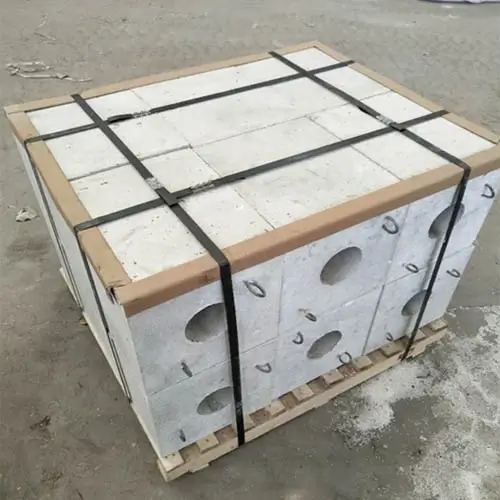
Common damage conditions of breathable bricks
(1) Peeling of the core of the permeable brick: When the ladle is placed in the converter after hot repair, the temperature inside the ladle is approximately 900℃, and the final temperature of the converter is approximately 1630℃. The rapid cooling and heating caused by the temperature difference leads to peeling of the core of the permeable brick, with a peeling thickness of 10-20mm. Furthermore, because the peeled portion has a tapered shape, it does not fall off, affecting the permeability of the molten steel in the ladle.
(2) Fracture of the permeable brick seat brick: The rapid cooling and heating caused by the temperature difference can also cause the permeable brick seat brick to fracture, with a fracture height of 100-200mm. The brick core, without the protection of the seat brick, will also fracture due to erosion by the molten steel. This type of fracture is extremely dangerous, especially in the later stages of the permeable brick’s use, where the remaining brick is short, easily leading to steel leakage at the bottom of the ladle. (3) Low strength and poor erosion resistance: When cleaning permeable bricks with an oxygen lance during hot repair, the normal cleaning rate is 9-12 mm/furnace. If the strength is insufficient, the brick core height decreases significantly with each cleaning, causing the permeable bricks to be used before their specified normal lifespan, affecting the normal turnover of the ladle and causing production instability.
(4) Steel erosion and damage: When inert gas is sprayed through the permeable bricks, the airflow impacts the exposed permeable bricks, creating a certain impact force. The high-speed flowing molten steel and airflow interact to form a vortex. When the permeable brick is higher than the permeable seat brick, its protruding parts are eroded and sheared by the vortex, forming annular grooves.
(5) Excessive oxygen burning damage: If the ladle is not recast in time after continuous casting, cold steel forms on the bottom of the ladle. It is necessary to use an oxygen lance to clean the permeable brick core by burning oxygen, which causes rapid damage to the permeable brick core.
(6) Irregular Burning of the Permeable Brick Core: When cleaning permeable bricks, the oxygen lance is used to press against the brick core. This concentrates the oxygen at one point, easily causing the brick core to burn unevenly, resulting in a sloping surface with a height difference exceeding 50mm. Irregular burning leads to poor air permeability, and each cleaning will exacerbate the imbalance, causing premature removal from production.
(7) Low Backflushing Gas Pressure: The backflushing gas is nitrogen at 0.5MPa, while the oxygen lance pressure is 0.8MPa. During oxygen cleaning, molten steel is blown into the narrow gaps of the permeable brick, clogging them after cooling and causing poor air permeability. Subsequent hot repairs will further damage the permeable brick core.
(8) Corundum Material Around the Permeable Brick and Brick Detachment at the Bottom: When constructing the bottom lining, a 50-100mm wide layer of self-flowing corundum material is poured around the permeable brick base to protect it. Due to insufficient strength of the corundum self-flowing material or construction problems, the corundum material around the permeable brick seat brick detaches, allowing molten steel to seep in and causing the permeable brick seat brick to fracture; alternatively, the bottom bricks around the permeable brick seat brick may fracture, with molten steel seeping in and causing the surrounding corundum material and the permeable brick seat brick to fracture.
Based on the analysis of these causes of damage, we conclude that the damage to permeable bricks is not only related to the material, shape, and structure of the refractory material itself, but also closely related to the usage environment, operation, and refining process. In the field of refractory materials, scholars both domestically and internationally are continuously conducting research and experiments, including selecting different additives, aggregates, and micro-powders to enable the refractory material to form a solid solution phase under high-temperature conditions, thereby increasing and improving the material’s thermal shock resistance, slag resistance, and other properties.