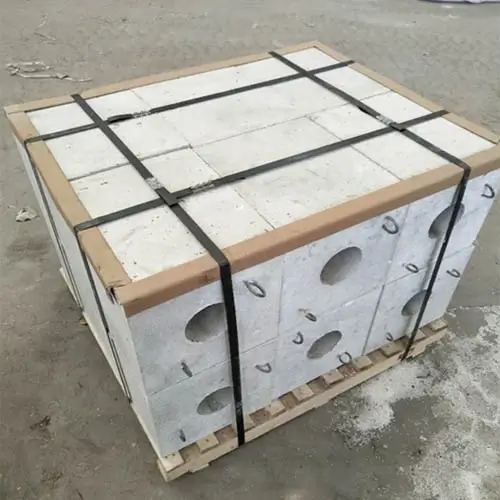
Discover a critical component that plays a vital role in industrial production: the furnace bottom gas-permeable brick.
In various high-temperature furnaces, the gas-permeable brick at the furnace bottom may seem unassuming, yet it acts like a silently dedicated “heart,” infusing the entire production process with a continuous stream of vitality. Let us unveil the mysteries of this component and delve into its world.
1.Classification of Materials for Furnace Bottom Porous Plugs
Gas-permeable bricks for furnace bottoms are made from a variety of materials, primarily the following types. First is sintered magnesia, which contains over 80% MgO; as a basic refractory material, it offers high refractoriness and strong resistance to alkaline slag erosion without contaminating the molten steel. However, it has a high coefficient of thermal expansion and poor thermal shock resistance, making it prone to spalling, which limits its service life. Magnesia-chrome materials, composed mainly of MgO and Cr2O3, address the issue of poor thermal shock resistance found in pure magnesia materials. High-alumina materials, with an Al2O3 content exceeding 48%, are characterized by high strength (both cold and hot), good wear resistance, thermal shock resistance, spalling resistance, and excellent volumetric stability at high temperatures, although their resistance to slag erosion and penetration requires improvement. Corundum-based materials contain more than 90% Al2O3—such as fused tabular alumina—with a formation process that facilitates self-purification.
2.Structural configuration of furnace bottom porous plugs
Gas-purging plugs for furnace bottoms come in a wide variety of structural designs. Common types include the diffuse type, which utilizes pore-forming agents and carefully controlled particle size distribution to create a network of interconnected, irregularly distributed pores of varying sizes and orientations. Another type is the straight-channel directional design, featuring straight holes or straight slits; while straight-hole designs are primarily used in converters, they have largely been replaced by straight-slit designs for ladles due to the complex manufacturing and low gas permeability associated with the straight-hole configuration. The slit-type directional design is the most widely adopted structure; it allows for the optimization of slit geometry based on specific operational conditions—such as the steel grade being refined, the process, and ladle capacity—thereby maximizing gas-purging efficiency, extending service life, and ensuring operational safety.
3.Location of porous plugs in the furnace bottom
Bottom-mounted gas-permeable bricks are widely used in the smelting process; they can be installed in transfer ladles, refining, degassing units, holding furnaces, intermediate furnaces, and launders, or pre-formed into base blocks for installation in the hearths of large reverberatory furnaces. In these applications, the bricks perform a unique function: by injecting inert gas, they refine the melt by removing impurities, prevent oxidation and hydrogen absorption, and reduce aluminum burn-off loss. Simultaneously, they enhance mass and heat transfer within the molten metal, thereby improving melting efficiency.
For instance, in holding furnaces, these bricks help maintain uniform temperatures and improve thermal retention; in refining/degassing units, they effectively remove impurities and gases, thereby enhancing the purity of the molten metal.
4.Components of the furnace bottom gas-permeable brick
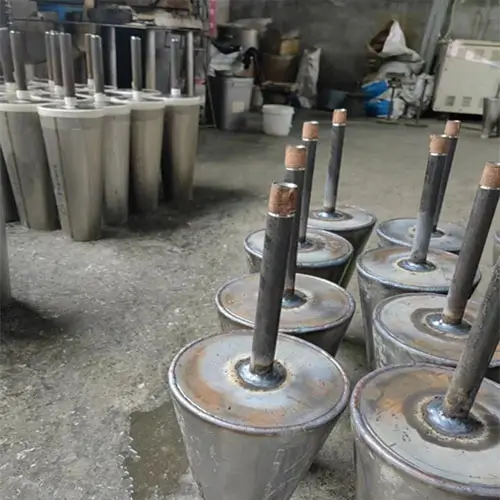
Furnace-bottom gas-permeable bricks typically consist of a permeable core, a gas chamber, a steel casing, and a gas inlet pipe. The permeable core is fabricated from composite materials via high-temperature sintering and features a diffuse permeability mechanism; it allows only gas to pass while preventing the ingress of molten metal—meaning it remains non-stick to aluminum and prevents molten aluminum penetration even when the gas supply is shut off. The gas chamber serves to store and distribute the gas, the steel casing provides protection and structural support, and the gas inlet pipe delivers gas to the chamber.
Taking a specific model of furnace-bottom gas-permeable brick as an example, the permeable core utilizes a specialized composite material processed through a meticulous sintering technique to create a uniform microporous structure, thereby ensuring the even outflow of gas.
5.The function of the furnace bottom porous plug
- Gas stirring: Blowing gases—such as nitrogen or argon—into the furnace intensifies the agitation of the melt, accelerates chemical reactions, and promotes greater uniformity in composition and temperature.
- Enhanced mass and heat transfer: It helps improve the efficiency of mass and heat transfer, thereby optimizing the production process.
- Increased production efficiency and quality: For instance, in steelmaking, it facilitates the flotation and removal of inclusions, thereby enhancing the purity of the molten steel.
6.Advantages of the New Type of Gas-Permeable Bottom Brick
This new type of gas-permeable brick for furnace bottoms offers numerous advantages. It enables pulsed gas supply and purging, resolving the long-standing issue of gas bubble coalescence; it allows for gas-only refining without the need for refining agents and facilitates uniform stirring for alloying. With a service life of at least three years—aiming to match that of the furnace hearth itself—it is suitable for both holding and melting furnaces, making it a smart choice for energy conservation, consumption reduction, and environmental protection in aluminum smelting.
In practical application, for instance, this new brick reduces temperature gradients, increases melting rates, lowers fuel consumption, and cuts equipment investment costs. It enhances the alloying process by combining alloying and purification functions, offers low investment costs with quick returns and simple maintenance, and completely eliminates the risk of molten aluminum leakage.
To select the appropriate material for furnace-bottom gas-permeable bricks based on specific operating conditions, consider the following factors:
- Furnace Temperature: If the internal temperature is extremely high, choose materials with high refractoriness, such as corundum or chrome-corundum. For relatively lower temperatures, high-alumina materials may suffice.
- Furnace Atmosphere and Slag Properties: If the atmosphere is oxidizing and the slag is acidic, corundum-based permeable bricks may be more suitable; in a basic slag environment, magnesia or magnesia-chrome materials may perform better.
- Thermal Shock Resistance: If the production process involves frequent and significant temperature fluctuations, select materials with excellent thermal shock resistance, such as high-alumina materials.
- Wear Resistance: In scenarios involving intense material flow and agitation, choose materials with high wear resistance, such as corundum.
- Chemical Stability: Consider the types and concentrations of chemical substances within the furnace and select materials that are chemically stable and resistant to reacting with the furnace contents.
- Cost Factors: Material costs vary significantly. While ensuring operational requirements are met, consider costs comprehensively to avoid excessive investment.
- Expected Service Life: If a long service life is required, choose materials with superior performance and durability.
- Production Process and Operating Conditions: Certain production processes may impose specific requirements regarding gas permeability or erosion resistance; select materials accordingly.
By comprehensively considering these factors, you can accurately select the right material for furnace-bottom gas-permeable bricks, ensuring that performance and service life meet production needs.
In summary, as a critical component in industrial production, the furnace-bottom porous plug plays an indispensable role in high-temperature furnaces thanks to its superior performance and vital function. It not only provides robust support for the stirring and homogenization of the melt within the furnace but also demonstrates immense value in enhancing production efficiency and improving product quality.